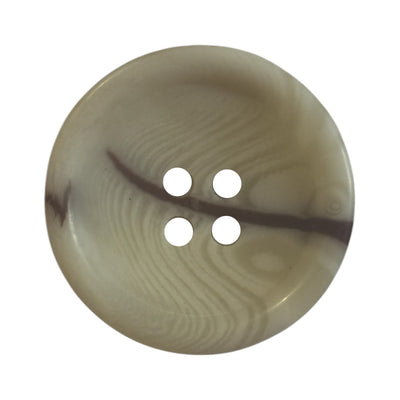
How many buttons per garment do you actually need? It sounds trivial until you're ordering for 80 shirts in three button sizes and come up three short on the day sewing starts. This post works as a practical calculator: typical button counts by garment, sizes in ligne and millimetres, how many spares to add and how gross packs work. It's written for ateliers and small brands ordering for the first time, but the logic scales to any production run.
First, the language of buttons
- Gross = 144 pieces (12 dozen). In wholesale, buttons are often counted and packed by the gross.
- Ligne (L) is the trade unit for button diameter. 1 L = 0.635 mm, so 40 L = 25.4 mm (one inch).
- Box lots: wholesalers often sell full boxes of 6, 12, 20 or 24 gross.
The most common sizes in ligne and millimetres:
| Ligne | mm (approx.) | Typical position |
|---|---|---|
| 14 L | 9 mm | Button-down collar |
| 16 L | 10 mm | Cuffs, sleeve plackets |
| 18 L | 11.5 mm | Shirt front |
| 20 L | 12.5 mm | Overshirt, blouse |
| 24 L | 15 mm | Jacket sleeve, trousers |
| 28 L | 18 mm | Cardigan, light outerwear |
| 32 L | 20 mm | Jacket front |
| 36 L | 23 mm | Trench, jacket |
| 40 to 45 L | 25 to 28 mm | Coat |
 Melange polyester buttons PG 265 Col 7 – shiny brown with a light pattern
 Polyester buttons PPB 0033
 Melange classic polyester buttons PB0106
Buttons per garment: a table by style
| Garment | Main buttons | Small buttons | Spares on label | Total (approx.) |
|---|---|---|---|---|
| Shirt, classic collar | 7 x 18 L (front) | 4 to 6 x 16 L (cuffs and plackets) | 1 to 2 | 12 to 15 |
| Button-down shirt | 7 x 18 L | 4 to 6 x 16 L + 3 x 14 L (collar) | 1 to 2 | 15 to 18 |
| Blouse | 6 to 10 x 16 to 20 L | 2 x 14 to 16 L (cuffs) | 1 | 9 to 13 |
| Single-breasted jacket | 2 x 32 L | 6 to 8 x 24 L (sleeves) + 1 inside | 1 large + 1 small | 11 to 13 |
| Trousers | 1 x 24 L (waistband) | 1 to 2 x 24 L (back pockets) + 1 inside | 1 | 4 to 5 |
| Single-breasted coat | 4 to 5 x 40 to 45 L | 4 to 6 x 24 to 28 L (sleeves) | 1 to 2 | 10 to 13 |
| Double-breasted coat | 6 x 40 to 45 L + 1 inside | 4 to 6 x 24 to 28 L | 1 to 2 | 12 to 15 |
| Cardigan | 5 to 7 x 24 to 32 L | none | 1 | 6 to 8 |
These are benchmarks. Always count from your own pattern: a style with flap pockets may add 2 to 4 buttons, and a double-breasted jacket can carry 4 to 6 on the front alone.
How many spares to add
Overage covers losses in sewing (a button cracked under the presser foot), inspection (badly attached and cut off), shipping and later repairs. Rules that work:
- Production runs: 3 to 5% of the total per size.
- Small runs (up to 50 garments): at least 5 to 10 pieces per size, whatever the percentage says; on small numbers, 3% is less than one button.
- Brittle materials (shell, small coconut): add another 2 to 3%.
- Styles you'll restock after the season: set aside a separate quantity from the same batch so the shade matches.
Tip: buttons from one batch share one shade. Reorder later, especially natural buttons such as corozo and coconut, and there may be a visible difference. Better a few extra now than mismatched buttons on the same rail.
Worked example: a small collection
An atelier is making 60 classic-collar shirts and 20 pairs of trousers. Shirt buttons are 18 L and 16 L; trouser buttons are 24 L.
- Shirts, 18 L: 7 front + 1 spare = 8 x 60 = 480 pcs.
- Shirts, 16 L: 6 (cuffs and plackets) + 1 spare = 7 x 60 = 420 pcs.
- Trousers, 24 L: 3 + 1 spare = 4 x 20 = 80 pcs.
- Production overage (5%, minimum 10 pcs): 18 L +24; 16 L +21; 24 L +10.
- Total: 18 L 504 pcs; 16 L 441 pcs; 24 L 90 pcs.
In gross, that's 3.5 gross of 18 L, just over 3 gross of 16 L and 0.6 gross of 24 L. If your supplier sells whole gross only, round up to 4 + 4 + 1. The surplus covers repairs and the next run.
Pairing sizes within one garment
A style usually uses two sizes of the same button: a large one for the front and a smaller one for cuffs or sleeves. Pick a model that comes in both sizes so colour and shape match. Our shirt buttons come in several sizes per model, and corozo buttons run from 15 to 25 mm. For outerwear, browse our coat buttons.
- Shirt: 18 L + 16 L (plus 14 L for a button-down collar).
- Jacket: 32 L + 24 L.
- Coat: 40 to 45 L + 24 to 28 L.
- Trousers: 24 L, sometimes 20 L for the inside button.
Special cases
Some styles need extra buttons that are easy to miss when counting: the inside anchor (jigger) button on double-breasted jackets and coats, brace buttons inside trousers, buttons on epaulettes and pocket flaps, and on shirts, the button at the back of the collar. For kidswear, add a bigger allowance, because those garments get repaired more often.
Pre-order checklist
- I've counted every size from the pattern, including pockets and inside buttons.
- I've added spare buttons for the care label.
- I've added production overage, as a percentage or a minimum number.
- I've checked how the model is sold (per piece, per gross, per box) and rounded up.
- I've recorded the model code and colour for reordering.
If you're ordering for a production run or a brand and need larger quantities, one model in several sizes or custom buttons, Bul-tex manufactures and supplies trims for workshops and labels. Get in touch via the contact page; we ship across the EU with DHL Express. You'll find more practical advice in our button articles.