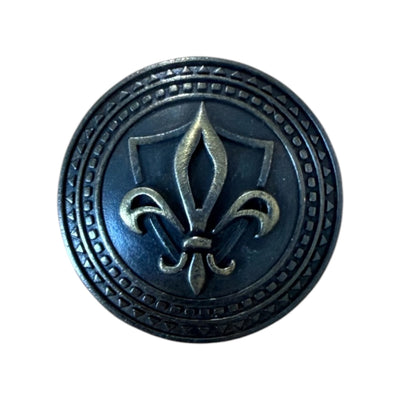
Shank buttons have a small loop or projection on the back that you sew through, instead of holes through the face. That seemingly minor detail solves a real problem: the button sits raised above the fabric, leaving room for the thick layer around the buttonhole. That is why shank buttons are the standard on coats, blazers, uniforms and knitwear. This glossary covers the types of shank, when to choose them and how to sew them on properly.
Sew-through vs shank: the core difference
| Sew-through (flat) button | Shank button | |
|---|---|---|
| Attachment | 2 or 4 holes through the face | A loop or projection on the back |
| Face | Holes are visible | A clean face with room for relief, crests or logos |
| Clearance from fabric | A hand-wound thread shank is needed on thick fabrics | The shank provides clearance already |
| Typical uses | Shirts, trousers, light dresses | Coats, blazers, uniforms, knitwear, decoration |
| Material | Anything: polyester, corozo, coconut, wood, metal | Mostly metal (zinc alloy, brass), also plastic and fabric-covered |
On metal buttons with a decorative face, such as crests, monograms and sculpted shapes, a shank is practically essential, since holes would break up the design. Most metal shank buttons are die cast in zinc alloy, because the face and shank are cast together in a single mould.
 Metal shank buttons 23972 Col 116 – Antique brass 22 mm
 Shank buttons 23972 – Gun Metal 22 mm
 Gold metal shank buttons MC 2110 PG Col 315 – 22 mm
Types of shank: a glossary
Loop shank
A wire loop soldered or crimped into the back of the button. A classic on hollow brass blazer and uniform buttons, it lets the button move freely.
Self-shank (cast shank)
The shank is part of the casting itself: a solid projection with a hole. Strong, with no joint between parts, and typical of zinc alloy crest and relief buttons.
Tunnel shank
A raised section on the back with two holes joined by a tunnel. The button sits lower and steadier and doesn't droop. Common on plastic and corozo buttons and some metal models.
Removable shank
The button is held by a ring, pin or spring clip passed through an eyelet on the inside, with no stitching. Used on uniforms and dress wear so buttons can be removed before washing or dry cleaning.
Shirt shank buttons
Small shank buttons of 8–11 mm for shirts, collars and cuffs. They look refined and are easier to fasten than flat ones.
Thread shank
Not a button type but a technique: on a flat sew-through button, the tailor wraps thread beneath the button to create an artificial shank. Useful when you want a holed button on a thick fabric.
When to choose a shank button
- Coats and heavy cloth such as wool, melton and bouclé. The shank accommodates the thickness of both layers at the buttonhole.
- Blazers and suits, especially with metal buttons: the face stays clean and looks luxurious.
- Knitwear and cardigans: a shank doesn't pull the stitches and the button lies naturally.
- Uniforms and crested blazers, for tradition and decorative effect.
- Premium shirts, with small shank buttons on collars and cuffs.
- Decorative details on pockets, epaulettes and sleeves where the button doesn't fasten.
When it's not a good choice: on close-fitting garments in thin fabric, where a shank button wobbles and drags, and on garments that are machine-washed often without protection, since metal shanks knock against the drum.
For garment factories and brands
In bulk production, shank buttons need more care than flat ones. Button-sewing machines must have a suitable shank button clamp, otherwise the button goes on crooked or the thread breaks on the edge of the shank. Check that the shank hole is smooth, free of sharp flash and wide enough for your thread. For heavy metal buttons, specify a backing button in the tech pack from the start rather than adding it as a fix after the first complaints.
Size: choosing a diameter
Button sizes are given in millimetres or lignes (1 ligne = 0.635 mm). As a rough guide:
- 8–11 mm (13–18L): shirts, cuffs, childrenswear;
- 15 mm (24L): blazer sleeves, waistcoats;
- 18–20 mm (28–32L): blazers, suits, light jackets;
- 22–25 mm (34–40L): coats and greatcoats;
- 28 mm and up: statement buttons and coats with strong styling.
The buttonhole should be about 2–3 mm longer than the button diameter, plus the button's height on domed models.
How to sew on a shank button, step by step
- Mark the position against the buttonhole: the button should land at the end of the buttonhole nearest the edge.
- Use strong thread, polyester or silk button thread, doubled.
- Align the shank parallel to the buttonhole so the button passes through easily.
- Make 6–8 stitches through the shank and fabric without pulling tight, letting the shank sit freely.
- On heavy coats, add a short thread shank under the metal one by winding the thread a few times between button and cloth.
- Reinforce from inside with a small backing button (a flat button or a fabric patch) for heavy buttons of 22 mm and up; it takes the strain.
- Finish off with a few small stitches on the inside and hide the thread end.
Tip: heavy metal coat buttons tear through thin interfacing over time. A backing button on the inside is a small detail that adds years to the garment.
FAQ
Can I replace sew-through buttons with shank buttons?
Yes, if the size matches the buttonhole. The shank will lift the button slightly, so check the garment still fastens comfortably.
Can shank buttons go in the washing machine?
Yes, but turn the garment inside out or use a laundry bag. For blazers and coats, dry cleaning is preferable.
Are shank buttons only metal?
No. Metal is the most common, but you'll also find shank buttons in plastic, corozo, wood and fabric-covered versions.
Bul-tex offers metal shank buttons in a range of finishes, including gunmetal, antique brass, gold and silver. Browse our metal buttons, coat buttons and shirt buttons. If you'd like shank buttons with your own crest or logo, get in touch: we take custom orders for brands.