Rubber vs spandex elastic sounds like a technical question, but the answer decides whether a waistband, a pair of briefs or a swimsuit lasts a year or goes baggy within months. On the roll the two look almost identical, because the elastic core is hidden under a polyester or cotton covering. The difference shows up in wear, in the wash, in the sun and against the skin. This article compares the two point by point and gives you a table for choosing by garment type.
What each one is
Rubber (elastodiene)
Rubber threads are made from natural latex or synthetic polyisoprene. On an EU fibre composition label, under Regulation No 1007/2011, they appear as "elastodiene". Rubber has high retractive power: the elastic pulls back hard even at low stretch. It is cheaper, which is why it is so common in mass production.
Spandex (elastane, Lycra)
Spandex is a synthetic polyurethane fibre. In Europe it is called "elastane", in the US "spandex", and Lycra is a brand name. It contains no natural rubber latex, it is finer, and it allows very thin, light and soft elastics.
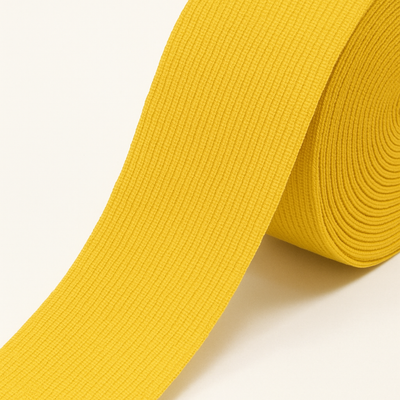
 Yellow braided elastic band PEL 1006 on a 25 m roll
 Pink knitted elastic band PEL 1014 on a 25 m roll
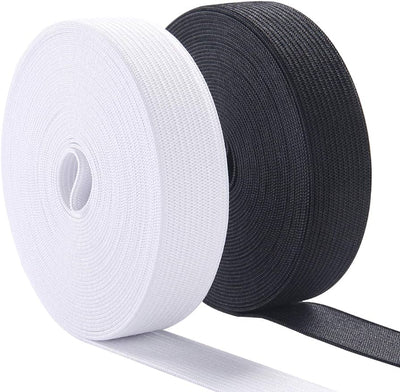
 Black flat woven elastic PEL 0002, 25 m roll
Point-by-point comparison
| Property | Rubber | Spandex |
|---|---|---|
| Retractive power | High for the width | Softer, more even |
| Weight and thickness | Heavier and bulkier | Lighter, very fine tapes possible |
| Latex | Yes (natural rubber) | No |
| Heat (washing, dryer, iron) | Sensitive, ages faster above 40 °C | More tolerant, but still dislikes the dryer |
| UV and ozone | Sensitive, perishes and cracks | Also sensitive, but more slowly |
| Sweat, oils, lotions | Sensitive | More resistant |
| Chlorine | Dedicated swim rubber copes well | Standard grades are vulnerable; chlorine-resistant grades exist |
| Cost | Lower | Higher |
Durability: what kills each elastic
Rubber performs very well until it meets heat, sweat and sunlight. These break down its polymer chains: the elastic turns tacky, then brittle, and finally loses its recovery. The classic example is an old tracksuit waistband that has no grip left and crackles faintly when you stretch it.
Spandex resists sweat, oils and cosmetics better, but it has weaknesses of its own: chlorine, nitrogen oxides from polluted air, UV and ozone. Standard spandex loses a significant share of its stretch after long exposure to chlorinated water, which is why swimwear uses either chlorine-resistant elastane or rubber made specifically for swimwear. We go deeper into that in our elastic articles, including one on swimwear elastic.
Allergies and skin contact
People with a latex allergy should avoid natural rubber elastic, especially in underwear and anything worn directly against the skin. Spandex is a polyurethane and contains no latex proteins, so it is the usual alternative. If you produce babywear or lingerie, choose elastic certified to OEKO-TEX Standard 100; for our WE woven elastics, that certification is stated in the product description.
Which elastic for which garment
| Garment | Recommendation | Why |
|---|---|---|
| Trouser, skirt or joggers waistband | Woven, rubber or spandex | Needs power; with heavy fabrics rubber is the economical choice |
| Underwear and bras | Spandex | Softness, low bulk, latex-free |
| Activewear | Spandex | Copes with sweat and frequent washing |
| Swimwear | Swim rubber or chlorine-resistant spandex | Chlorine and salt water |
| Childrenswear | Spandex, OEKO-TEX | Safety and softness |
| Workwear | Woven rubber | Power and low cost at volume |
Washing tips that extend elastic life
- Temperature: 30–40 °C is ideal for both. At 60 °C rubber ages noticeably faster.
- Tumble dryer: avoid it. Hot air is the quickest way to "bake" elastic.
- Bleach: chlorine bleach harms both materials.
- Fabric softener: use sparingly, as it can soak into the covering and reduce grip.
- Iron: never directly on the elastic; use a low setting or a pressing cloth.
- Drying: in the shade rather than in direct sun, particularly for rubber.
Quick workroom test: stretch the elastic to its limit and hold it for 10 seconds. If it doesn't spring back almost to its original length, or the surface puckers, the core or the heat-setting is poor quality.
Myths and facts
- Myth: "Spandex is just pricier rubber." Fact: they are different polymers. Rubber is polyisoprene, spandex is a segmented polyurethane. They differ in power, weight, durability and in how they react to chlorine and UV.
- Myth: "The harder elastic pulls, the better it is." Fact: power has to match the garment. Elastic that is too strong on underwear digs into the skin, while elastic that is too weak on a waistband won't hold trousers up.
- Myth: "Elastic goes slack simply because it's old." Fact: the usual culprit is heat, whether from a tumble dryer, a hot iron or 60 °C washes, or poor heat-setting at the factory, rather than age itself.
- Myth: "All swimwear elastic is the same." Fact: ordinary spandex elastic loses power quickly in a pool. You need dedicated swim rubber or chlorine-resistant elastane.
- Myth: "A cotton covering makes the elastic cotton." Fact: the covering decides the feel and look, but stretch behaviour and ageing depend entirely on the core.
How to tell which one you have
Check the label or technical sheet: "elastodiene" or "rubber" means rubber; "elastane", "spandex" or "PU" means spandex. If there is no information, cut the end. Rubber threads are usually thicker, round or square and slightly tacky, while spandex filaments are very fine and numerous.
FAQ
Which elastic is stronger?
Rubber gives more power at the same width, but spandex usually lasts longer in garments that are washed often and worn during exercise.
Can rubber elastic be washed at 60 °C?
It will technically survive, but it will age much faster. For a long life, wash at 40 °C or below.
Do you stock elastic in different widths?
Yes, our elastic collection includes woven and knitted styles from 1 to 10 cm. For production elastic made to your specification, contact us.