Custom logo waistband elastic is probably the most visible branding detail in underwear and activewear. The logo on the waistband is seen every time the garment is worn, in every product photo and often above the line of the trousers. For a small or growing brand, a well-made jacquard waistband is the difference between "nice product" and "recognisable brand". This buyer's guide covers everything you need to decide before ordering: technique, width, material, colours, artwork, sampling and quantities.
Step 1: Choose the logo technique
| Technique | Look | Durability | Best for |
|---|---|---|---|
| Jacquard (woven or knitted in) | Logo is part of the structure, single or double sided | Highest, never wears off | Boxers, sports bras, leggings |
| Heat transfer | Bright, detailed graphics and gradients | Good, depends on the film quality | Complex logos, short runs |
| Screen print | Solid, slightly raised print | Good with the right ink | One or two-colour logos |
| Embossed or debossed | Subtle tone-on-tone logo | High | Minimal and premium brands |
| Metallic yarn | Shiny logo within the jacquard | High, but stiffer to the touch | Limited editions, fashion |
Jacquard is the standard for underwear because the logo can't wash out and the elastic stays soft. Printing is more flexible for complex artwork and smaller quantities, but it can crack after frequent hot washes.
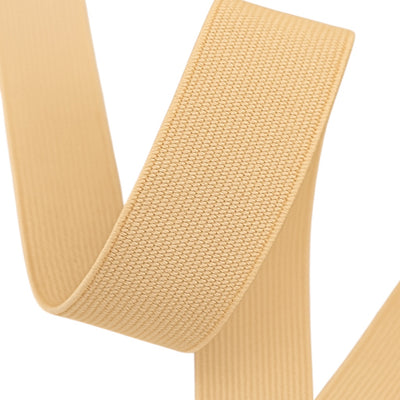
 Flat woven elastic beige PEL 0004, 25 m roll
 Brown braided elastic band PEL 1005 on a 25 m roll
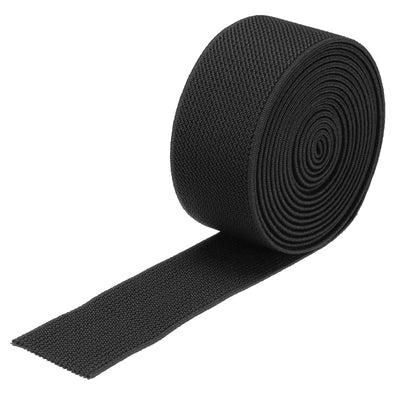
 Black wide woven elastic 6 cm WE 1060 – strong and firm elastic with Oeko-Tex certificate
Step 2: Decide the width
Logo waistbands typically run from 25 to 60 mm wide, and for sport and menswear styles they can reach 10 cm. As a rough guide:
- 20–30 mm: women's briefs, bikinis, slim waistbands.
- 35–45 mm: men's briefs and boxers, sports bras.
- 50–60 mm: premium boxers, leggings, gym shorts.
- 70–100 mm: joggers and wide athletic waistbands.
A wider band offers more room for the logo and more comfort, but it needs more precise waist patterning and more elastic per piece.
Step 3: Material and handle
Most logo elastics are nylon or polyester combined with spandex. Nylon is softer with a nicer sheen; polyester resists fading better and costs less. The back can be brushed (plush) for a soft feel on the skin. For childrenswear and lingerie, ask for materials that meet OEKO-TEX Standard 100 and REACH restrictions.
Step 4: Colours
In jacquard, colour comes from the yarns themselves, so you work with Pantone references (TCX or TPX for textiles). The more colours in the logo, the more complex the weave. A one or two-colour logo is the most economical and usually looks cleanest. Think about contrast too: a white logo on a black band is a classic, while tone-on-tone feels premium.
Step 5: Prepare your artwork
- Send the logo as a vector file (AI, EPS, PDF or SVG) with fonts converted to outlines.
- State the logo height in mm, usually 50–70% of the elastic width.
- Set the repeat, meaning how often the logo recurs, for example every 15–25 cm.
- Avoid very fine lines under 0.5 mm and tiny lettering; they get lost in jacquard.
- Give Pantone references for both ground and logo.
Tip: work out the repeat so the logo lands dead centre at the front on your best-selling size. That way the logo is always complete in your product shots.
Step 6: Sampling and approval
Always get a sample (a strike-off or short trial length) before bulk production, and test it in real conditions:
- Sew it onto a garment and wear it for a few days.
- Wash it 5–10 times at the temperature that will appear on your care label.
- Measure width and length before and after washing.
- Check that dark colours don't bleed onto light fabric.
Step 7: Quantities and lead times
With jacquard elastic, minimums exist because the loom has to be set up for your design. Across the industry they vary widely, from a few hundred to more than a thousand metres per colour, with around 500 m per colourway being common. Work out how much you need: a pair of boxers with a relaxed waist of around 80 cm takes roughly 0.7–0.9 m of elastic, plus 5–10% waste. So 500 m covers roughly 550–650 pieces.
Lead time covers artwork preparation, sampling, approval and production. Plan the order alongside your cutting schedule, not at the last minute.
Common mistakes when ordering logo elastic
- Logo too close to the edge. Overlock or zigzag stitching partly covers the edges of the band. Leave at least 3–5 mm of clear margin on each side.
- Ignoring wash shrinkage. If the elastic shrinks by a few percent, the repeat and waist measurement will drift. Ask for shrinkage data or measure it on your sample.
- One band for every style. A single width rarely suits both women's briefs and men's boxers. Ordering two widths in one design can be the smarter move.
- Too many colours. Every extra colour complicates the weave and adds set-up time without necessarily improving the look.
- No buffer stock. Re-setting a loom for a small top-up is poor value. Order enough for at least one more run, especially for your core styles.
Pre-order checklist
- Logo technique (jacquard, print, emboss).
- Width and thickness.
- Composition and back finish (smooth or brushed).
- Pantone colours.
- Vector file, logo height, repeat.
- Certification needs (OEKO-TEX, REACH).
- Quantity per colour and target date.
- Packing: rolls and roll length.
How we work with brands
Bul-tex manufactures and supplies garment trims for brands and ateliers and takes orders for elastic made to specification. Send us your logo, preferred width, colours and approximate quantity through our contact form and we'll come back with concrete terms. If you need standard elastic for samples or short runs, browse our elastic collection. For a complete garment branding package, see our labels and our manufacturing articles.