Swimwear elastic is one of the few trims that works in a genuinely hostile environment: chlorinated water, salt, sun, sunscreen and sand. Ordinary elastic from your sewing drawer can last for years on dry land, yet lose its power in a single pool season. The result is familiar: bottoms sag, necklines gape and the elastic inside turns to mush. This guide explains what happens to elastic in water, which types survive and how to sew and care for swimwear so it lasts.
Why ordinary elastic fails in the pool
Most garment elastics contain spandex (elastane) wrapped in polyester or nylon. Spandex is a polyurethane and it is sensitive to chlorine: the oxidisers in pool water break down its polymer chains. Industry figures suggest untreated spandex can lose a substantial share of its elasticity, with estimates of around 40%, after roughly 100 hours in chlorinated water. A regular swimmer racks up 100 hours in just a few months.
Salt water is less aggressive than chlorine, but the salt crystals left after drying are abrasive, and the combination with UV and sun lotion speeds up ageing. Natural rubber elastics, meanwhile, are sensitive to oils, including the oils in sunscreen.
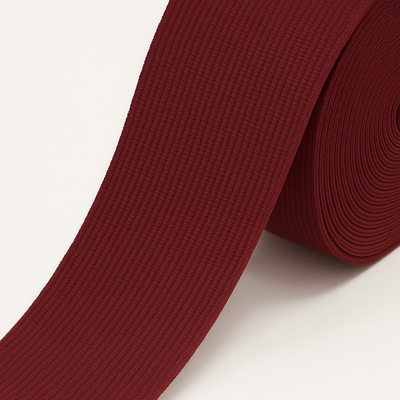
 Bordeaux knitted elastic band PEL 1013 on a 25 m roll
 Wide white knitted elastic band
 Red knitted elastic band PEL 1008 on a 25 m roll
Types of swimwear elastic
| Type | Chlorine | Salt water | Pros | Cons |
|---|---|---|---|---|
| Swim rubber (bare or covered) | Very good | Very good | Strong, thin, doesn't absorb water, cheap | Sensitive to oils and UV; contains latex |
| Chlorine-resistant spandex | Good | Good | Soft, latex-free, light | Pricier, hard to find in small quantities |
| Standard knitted spandex elastic | Poor | Fair | Widely available | Loses power fast in pools |
| Cotton-covered elastic | Fair | Fair | Soft handle | Absorbs water, dries slowly, fades |
| Clear polyurethane elastic | Fair | Good | Invisible, stabilises seams | Not a main elastic for openings |
Swim rubber
This is the professionals' classic. It is usually a narrow 6 to 10 mm tape, often bare (no textile covering), white or a translucent beige. Since it is sewn inside the hem, colour doesn't matter. Swim rubber is formulated specifically to resist chlorine and salt and it doesn't absorb water, so the swimsuit doesn't get heavy. In Spanish haberdashery it is known as "goma virgen", the standard swimsuit elastic.
Chlorine-resistant spandex
A modified elastane developed for swimwear and used by higher-end swim brands. It lasts many times longer than standard spandex in a pool and suits products that must be latex-free. If you are producing a run, ask your supplier for chlorine-resistance data.
Important: elastic is only as durable as the fabric around it. Chlorine-resistant elastic inside an ordinary stretch fabric will outlive the swimsuit itself. Pair the elastic with fabric made for pool use.
Widths and placement
- Bottom leg openings: 6–8 mm.
- Bottom waist: 8–10 mm; for swim shorts, 20–30 mm in a casing.
- Top neckline and armholes: 6–8 mm.
- Underbust on a bikini top: 10–15 mm for better support.
- Straps: 6–10 mm, enclosed inside the strap.
How to sew it
- Shorten the elastic. For legs, cut it at about 80–90% of the opening, with most of the reduction at the back. For necklines, 85–90%. Test first, because rubber pulls harder than standard elastic.
- Attach with an overlocker or zigzag to the wrong side of the edge, stretching only the elastic.
- Turn the elastic under once so it is completely enclosed in fabric.
- Topstitch with a coverstitch or three-step zigzag at about 2.5–3 mm.
- Use polyester thread, never cotton, which rots and weakens in chlorine. Use a stretch needle.
Avoid piercing the rubber more than necessary with a straight needle, since every hole weakens the tape. Stitches that ride over the elastic are preferred for that reason.
Testing elastic before a production run
If you make swimwear to sell, don't rely on the supplier's description alone. A simple workroom test can save you a wave of returns:
- Cut two 20 cm pieces of the elastic and mark the length with a pen.
- Keep one dry as a control and sew the other into a hem of your swim fabric.
- Soak the test piece in chlorinated water, such as pool water or a heavily diluted bleach solution, for a few hours a day over a week. Rinse and dry between cycles.
- Compare the two pieces: stretch both with the same force, measure the length, and check whether the test piece fully recovers and hasn't turned tacky or brittle.
- Check the stitching too: has the thread kept its strength, and has the fabric around the elastic faded?
It is no substitute for lab testing, but it quickly shows whether an elastic is fit for pool use. If the loss of power is visible to the naked eye after a week, look for a more resistant option.
Care: making swimwear last
- Rinse in cool tap water straight after the pool or the sea.
- Hand wash with a mild detergent, no bleach and no fabric softener.
- Don't wring it out; press it in a towel instead.
- Dry flat in the shade, away from radiators and direct sun.
- Avoid sitting on rough surfaces such as pool edges, which abrade the fabric and expose the elastic.
- Rotate two swimsuits if you swim often, as elastic recovers better between wears.
FAQ
Can I use ordinary elastic in a swimsuit for one season?
For a swimsuit worn occasionally at the beach, a standard knitted elastic will hold up for a while. For pool use and regular swimming, use swim rubber or chlorine-resistant spandex.
Why is rubber recommended if it's so sensitive?
Swim rubber is a special formulation, different from the ordinary rubber in waistbands. It resists chlorine and salt, and its sensitivity to oils is managed by rinsing after every wear.
Do you stock elastic for swimwear?
Our elastic collection includes woven and knitted elastics in a range of widths suited to swim shorts and casings. If you need a specific elastic for swimwear production, contact us with your requirements. Read more about materials in our elastic articles.