Underwear elastic is the detail that decides whether boxers, briefs or panties feel comfortable all day, or dig in, roll over and go slack after a few washes. The fabric can be perfect, but if the elastic is wrong in width, power or feel, the garment comes back as a return. In this guide we split underwear into zones (waistband, leg openings, neckline and straps) and explain for each one which elastic works best, at what width and how to cut it.
The main types of underwear elastic
Plush-back elastic
One side is brushed and soft, the other smooth. The plush side goes against the body. It is used on the waist and legs of briefs and panties when the elastic is exposed and sewn on the outside. Typical widths are 10–20 mm for legs and 15–30 mm for waistbands.
Picot (lingerie) elastic
It has a decorative edge of tiny loops along one side. It is sewn with the picot edge facing out so it shows as a delicate finish. A classic on women's panties, bras and necklines, usually 6–15 mm wide.
Fold-over elastic (FOE)
It has a groove down the middle and folds over the raw edge of the fabric like binding. Great for panties, children's underwear and pyjamas, since it replaces both a hem and an elastic in one step. Unfolded width is 15–25 mm.
Wide logo or jacquard waistband
An exposed band of 25 to 60 mm, typical of men's boxers and sports underwear. It is sewn on top of the waist, often with a coverstitch. Our elastic articles include a full guide to ordering one.
Enclosed elastic in a casing
Woven or knitted elastic of 20–35 mm threaded through a fabric casing. It is used on classic woven boxer shorts and pyjama bottoms. Woven elastic is the better choice here because it won't roll inside the casing.
Clear elastic
A thin polyurethane tape, 4–10 mm, that stabilises shoulder and neckline seams in knits without showing. It is a support elastic, not a waistband elastic.
 Orange knitted elastic band PEL 1007 on a 25 m roll
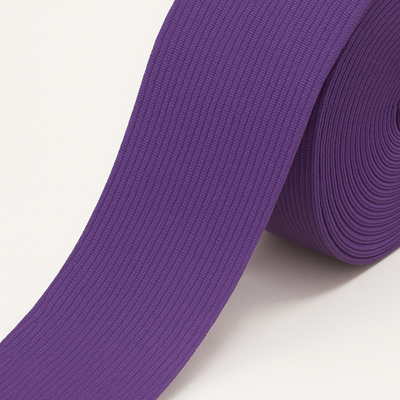
 Purple knitted elastic band PEL 1015, 25 m roll
 Flat woven elastic band white PEL 0001 on a 25 m roll
Which elastic goes where
| Garment and zone | Elastic type | Width | Application |
|---|---|---|---|
| Jersey boxers, waist | Wide band, jacquard or plush | 30–50 mm | Exposed, coverstitch or zigzag |
| Woven boxers, waist | Woven elastic in a casing | 25–35 mm | Enclosed |
| Briefs, waist | Plush or jacquard | 15–35 mm | Exposed or turned in |
| Briefs, legs | Plush or knitted | 8–12 mm | Turned and topstitched |
| Panties, waist | Picot or plush | 10–15 mm | Exposed, picot facing out |
| Panties, legs | Picot or FOE | 6–12 mm | Exposed or folded as binding |
| Children's underwear | Soft plush or FOE | 10–20 mm | No hard pressure on the skin |
How much shorter to cut the elastic
Elastic is always cut shorter than the opening it will gather, so it stretches as you sew and then pulls the fabric in. Starting points:
- Waist of briefs and panties: 80–90% of the opening.
- Leg openings: 85–95% of the opening, with most of the reduction placed at the back, where a closer fit is needed.
- Boxer waistband: 85–90% of the garment's waist measurement.
The exact figure depends on the power of the specific elastic, so always sew a test piece. A powerful elastic can be cut longer, a soft one shorter.
Tip: divide both the elastic and the opening into quarters and mark them with pins. While sewing, stretch the elastic evenly between the marks so the gathers are even and there are no ripples.
Sewing the elastic on properly
- Join the elastic into a loop with a 1 cm overlap and a few rows of zigzag, or sew it on flat and close it with the final seam.
- First pass: place the elastic on the right side of the fabric (plush side up if it will be turned in) and sew along the edge with a wide zigzag, stretching slightly.
- Turn the elastic to the inside so it encloses the raw edge.
- Second pass: three-step zigzag or coverstitch from the right side, again stretching gently.
- Stretch only the elastic, never the fabric, or the edge will go wavy.
Use a stretch or ballpoint needle and strong polyester thread; cotton thread can snap when the seam stretches.
What to look for when buying
- Feel: if the elastic sits directly on skin, a brushed side is essential for comfort.
- Composition: spandex is softer and latex-free; rubber is stronger but sensitive to sweat and heat.
- Certification: for underwear, and especially babywear, look for OEKO-TEX Standard 100. Our WE woven elastics carry this certification according to their product descriptions.
- Recovery: stretch the elastic hard and let go; it should snap back fully and immediately.
- Colourfastness: dark elastic on light underwear must not bleed.
Troubleshooting
The waistband rolls. The elastic is too narrow, or it is a knitted elastic in a casing. Switch to a wider woven elastic, or sew it down with two rows of stitching.
Leg openings dig in. The elastic was shortened too much or is too powerful. Add 3–5% to its length.
Stitches snap when the garment is pulled on. You used a straight stitch or a zigzag that is too short. Switch to a wide or three-step zigzag.
The elastic goes slack after a few washes. Usually the tumble dryer or hot water is to blame; wash underwear at 30–40 °C and line dry.
FAQ
What elastic should I use for boxers?
For jersey boxers, an exposed band of 30–50 mm; for woven cotton boxers, a 25–35 mm woven elastic in a casing.
Can I use ordinary elastic for underwear?
Yes, if it is enclosed in a casing. If the elastic touches the skin directly, pick a soft knitted or plush-back elastic.
Do you stock underwear elastic in different colours?
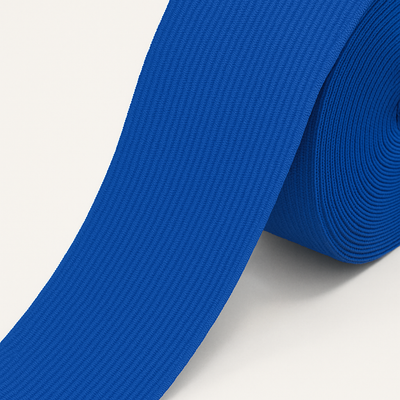
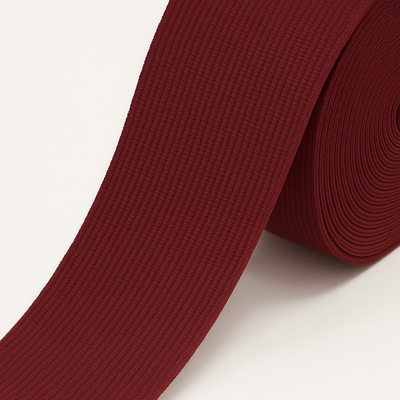
Our elastic collection includes knitted and woven styles in many colours and widths from 1 to 10 cm. For custom elastic with a logo, brushed back or a specific shade, get in touch. To finish your underwear line, take a look at our labels too.