Elastic for sleeves and cuffs turns a plain sleeve into a puff sleeve, keeps the wind out of a jacket cuff and holds jogger legs just above the ankle. Unlike a waistband, these openings are small, so every centimetre counts. Here is how to choose the width, calculate the length and decide when elastic beats a rib cuff or a button.
Where elastic is used in sleeves and hems
- Wrists of blouses, dresses and pyjamas – a soft gather that stays out of the way.
- Puff sleeves – elastic above the elbow or on the upper arm for volume.
- Jacket and trench coat cuffs – partial elastic on the inside only, to block the wind.
- Jogger legs – elastic at the ankle.
- Jacket or sweatshirt hems – a wider elastic that draws in the bottom edge.
 White knitted elastic band PEL 1001, 25 m roll
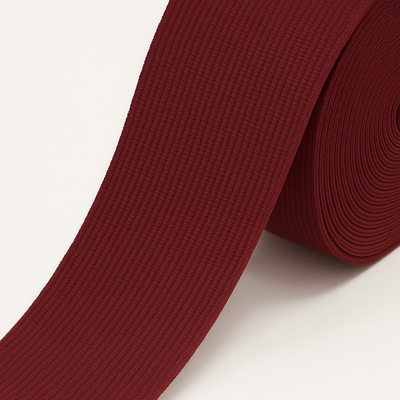
 Bordeaux knitted elastic band PEL 1013 on a 25 m roll
 Brown braided elastic band PEL 1005 on a 25 m roll
Which width to choose
| Placement | Elastic width |
|---|---|
| Wrist of a blouse, dress or kids' garment | 0.5–1 cm |
| Puff sleeve, upper-arm gather | 1–1.5 cm |
| Jacket or trench coat cuff | 1.5–2.5 cm |
| Jogger ankle | 2–3 cm |
| Jacket or sweatshirt hem | 3–4 cm |
For fine fabrics choose a narrower, softer knitted elastic. With heavier fabrics such as denim, nylon shell or fleece, woven elastic is the better pick because it does not twist inside the casing.
How to calculate the length
Sleeves come with one important condition: the garment still has to go on. So you measure not only the wrist, but also check against the hand and the heel.
- Wrist: wrist circumference + 1–2 cm. Stretch the elastic and check it slips easily over a closed hand.
- Puff sleeve on the upper arm: arm circumference at that point minus 1–3 cm.
- Ankle: ankle circumference + 2–3 cm, then check the stretched elastic passes over the heel.
- Jacket hem: hip circumference minus 10–15%.
- Add 1.5–2 cm for the overlap if the elastic is joined into a loop.
For children, allow a little more ease – elastic that is too tight at the wrist leaves marks and restricts circulation.
Casing or sewn-on in a sleeve
For wrists and ankles the easiest method is to turn the edge twice, stitch a casing 3–5 mm wider than the elastic and thread the elastic through with a safety pin. Leave a 2–3 cm gap, overlap and stitch the ends, then close it. For puff sleeves, where the elastic sits higher than the edge, sew a narrow tape on the inside as a casing, or zigzag the elastic straight on while stretching it evenly. When sewing several matching sleeves, cut all the elastic pieces at once so both sides come out symmetrical.
Partial elastic in a jacket cuff
On jackets, trench coats and workwear, elastic is often placed only in the back half of the cuff. Cut a piece about two thirds the length of the section you want to gather, anchor one end with a straight stitch and stretch it to the other end of the section as you sew. The front of the cuff stays smooth while the back hugs the wrist. Combine it with an adjustable tab and a snap fastener if you want extra tightening.
Frequently asked questions
How wide should sleeve elastic be?
For blouse and dress wrists, 0.5–1 cm. For jacket cuffs, 1.5–2.5 cm. Wider elastic gives a sportier look.
How do I work out elastic for a puff sleeve?
Measure the arm where the gather will sit and subtract 1–3 cm. The wider the sleeve pattern, the fuller the puff will be.
Elastic or rib cuffs for joggers?
Rib cuffs look more finished but need suitable ribbing fabric. Elastic in a casing is quicker and easy to replace when it wears out.
Find narrow and wide options among Bul-tex elastics, and for adjustable cuffs explore our snap fasteners and accessories.