Magnetic snaps for bags are the most convenient closure for a bag flap, wallet or case: they close in one movement without hunting for a buttonhole and open with a gentle tug. But the choice between 14 and 18 mm, between prong and sew-in styles, and a proper installation with a reinforcing backing decide whether the snap lasts for years or tears out of the fabric within a month. Here is everything you need to know.
What a magnetic snap consists of
A standard bag magnetic snap has four parts:
- Male half: with a raised centre that fits into the female half.
- Female half: with a recessed centre that receives the male.
- Two washers: metal discs with two slots, placed on the reverse side to spread the load.
Each half has two metal prongs that pass through the fabric and are bent over the washer. The magnet sits inside the metal housing, so you never see it.
 Metal eyelets PE 0002 flat
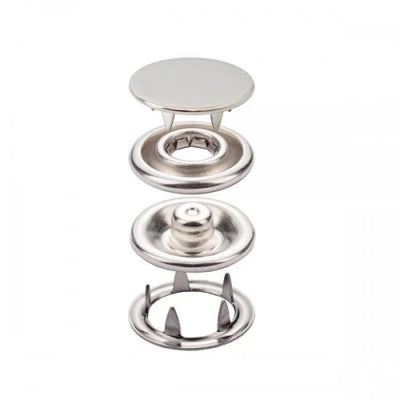
 Snap fasteners E-2278 Gun Metal 40 mm – 4 pieces, "Teardrop" design, Luxury model
 Metal eyelets PE 0003 – oval
Sizes: 14 mm or 18 mm?
| Size | Best for | Holding strength |
|---|---|---|
| 10–12 mm | Coin purses, card cases, jewellery boxes | Light |
| 14 mm | Wallets, clutches, small pouches, phone cases | Moderate |
| 18 mm | Shoulder bags, totes, flap backpacks | Strong |
| 20 mm and up | Large shoppers and beach bags, heavy flaps | Very strong |
The most common sizes are 14 mm and 18 mm. The rule is simple: the heavier the flap and the more the bag carries, the bigger the snap. A 14 mm snap on a large tote will pop open with every movement, while an 18 mm snap on a wallet looks bulky and is hard to open.
Attachment types
Prong
The most common type. It needs no special tools, just something sharp for the slits and something hard to bend the prongs. It suits fabric, faux leather and thin leather.
Sew-in
The housing has holes around the rim and is sewn on like a button. Use it where you do not want prongs going through the fabric, for example on fine fabrics or where the reverse side is visible.
Hidden sew-in magnets
A flat magnet enclosed in a PVC or fabric pouch that is stitched between layers. Nothing shows on the outside. Ideal for jackets, wraps, garments and flaps where you want no visible hardware.
Installation step by step (prong type)
- Install before assembling the bag. Fit the snap to the flap and to the body (or lining) while the pieces are still separate. Once the bag is sewn, reaching the inside is very awkward.
- Reinforce the spot. Fuse or stitch a piece of interfacing, dense felt, leather or bag foam about 3 x 3 cm on the inside. Without it, the prongs will tear the fabric on the first hard pull.
- Mark the centre. The male half usually sits 1.5–2.5 cm from the edge of the flap. Centre the washer on the point and mark both slots with a fabric marker.
- Cut the slits. With a seam ripper, small chisel or craft knife, cut two short lines exactly as wide as the prongs. No wider, because a loose slit weakens the hold.
- Insert the half. From the right side, push the prongs through the slits.
- Add the washer on the reverse, threading the prongs through its slots.
- Bend the prongs. Use the back of scissors, a ruler or pliers to bend the prongs outwards (more stable) or inwards towards the centre, flat against the washer.
- Find the matching position. Dab chalk or lipstick on the male half, close the flap and press. The mark shows exactly where the female half goes.
- Repeat steps 2–7 for the female half.
Tip: glue a small circle of leather or felt over the washer on the inside. The metal edges will not scratch the bag's contents and the lining will not wear through.
Finishes and style
Magnetic snaps come in nickel (silver), gold, antique brass and gunmetal. Match the finish to the rest of the bag's hardware, such as rings, buckles and rivets. A bag looks far more professional when every metal part is in the same tone. For more on matching metals, see our articles on accessories and hardware.
A word of caution: cards and electronics
The magnets in bag snaps are small but strong enough to affect some items in prolonged contact:
- magnetic-stripe cards (older bank cards, hotel key cards, parking cards) can be demagnetised;
- compasses and some watch sensors may read inaccurately;
- anyone with a medical implant such as a pacemaker should follow their doctor's and the manufacturer's guidance on magnets.
The practical answer is not to put card slots directly beneath the snap, and in wallets to use a 14 mm snap placed away from the card pockets. Chip cards and contactless payment are generally unaffected, but distance never hurts.
Common problems
| Problem | Cause | Fix |
|---|---|---|
| Snap tears out | No reinforcement | Interfacing, felt or leather backing |
| Flap opens by itself | Snap too small | Upgrade to 18 mm |
| Halves do not meet | Inaccurate marking | Mark with chalk with the flap closed |
| Housing spins | Slits too wide | New position or larger washer/backing |
FAQ
Magnetic snap or press snap?
A magnetic snap is easier for frequent opening and needs no force. A press snap holds more securely and does not affect cards, which often makes it the better choice for backpacks and travel bags. See the snap fasteners in our catalogue.
Can a bag with a magnetic snap be washed?
By hand at a low temperature, yes. Machine washing and tumble drying knock the metal against the drum and can damage the finish.
Can I use a magnetic snap on clothing?
Garments use hidden sew-in magnets or press snaps. Visible prong magnetic snaps are too rigid for most clothing.
Bag hardware from Bul-tex
For bag flaps and pockets our catalogue offers snap fasteners and metal eyelets, and for handles and straps there are rings. If you produce bags in runs and need magnetic closures in a particular size and finish, contact us and we will look into the options. We ship with DHL Express across the EU.