This bag hardware guide covers the part of a design you rarely notice until something breaks: a ring opens, a buckle bends, a strap comes loose. Well-chosen metal hardware makes a bag strong, comfortable and expensive-looking. In this glossary you will find every core metal part, what it does, the sizes it comes in, and sample hardware lists for three popular styles: a tote, a crossbody and a backpack.
The sizes you need to know
Most bag hardware is sized by its inside width, meaning how wide a webbing or leather strap can pass through it. The most common sizes are 20 mm (3/4 inch), 25 mm (1 inch) and 38 mm (1.5 inch). 20 mm suits small pouches and clutches, 25 mm most crossbody and shoulder bags, and 38 mm backpacks, totes and wide straps. The key rule: every part along one strap must share the same inside width, or the strap will bunch or slip.
 Rectangular fabric-covered slim buckles FCB0003 – 5 cm
 Metal rings E-2315 Nickel – Buckle type, Oval model with beads – 2.5 cm
 Metal buckle E-2312 Gold-tone 4 cm – Sea Snail Shape, Designer buckle for Belts and Clothing
Glossary of metal bag hardware
D-ring
A ring shaped like the letter D. The straight side is sewn to the bag with a small tab of fabric or leather, leaving the curve free to take a strap or a swivel hook. The single most used part on any bag.
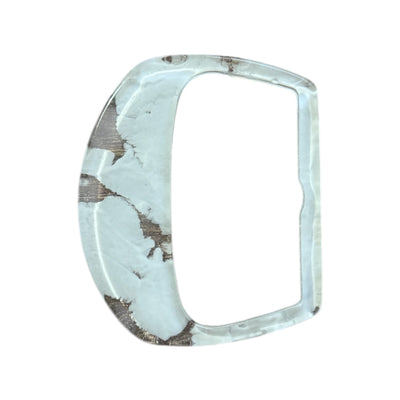
Rectangle ring
A rectangular frame with no centre bar. It serves as an anchor point for a handle, or pairs with a slider to make an adjustable strap. The strap lies flat inside it without bunching.
O-ring
A closed circle. Good for decorative details, rope handles and anywhere a strap needs to swivel freely.
Slider (tri-glide)
A rectangular frame with a centre bar. The strap wraps around the bar and is held by its own friction, so length can be adjusted without the strap slipping. We cover it in detail in our article on adjustable straps.
Swivel hook (snap hook)
A hook with a spring gate and a rotating base. It lets a strap be detached and clipped to D-rings, and the swivel stops the strap from twisting.
Buckle
A closing or adjusting frame, with or without a prong. On bags it is used for leather straps with holes, flap straps and decorative details.
Strap anchor
A metal bracket that attaches a handle to the bag body and spreads the load. Often fitted with screws or rivets.
Rivet
Two metal parts pressed together through all the layers. Rivets reinforce stress points, such as handle bases and pocket corners, where stitching alone would give way.
Eyelet (grommet)
A metal ring with a washer that forms a strong hole for a drawcord, rope or ventilation. Typical on drawstring bags and backpacks.
Magnetic snap and press snap
Closures for flaps and pockets. The magnetic one is more convenient; the press snap holds more securely.
Purse feet
Small metal studs on the base that protect the bag from dirt and wear when you set it down. Usually 4 or 5, fitted with prongs.
Zip puller
A metal or leather tab attached to the zip slider, often carrying the brand logo.
Finishes
Bag hardware is mainly sold in nickel (silver), bronze or antique brass, gold, and black or gunmetal. For a coherent look, choose one finish for all parts: rings, sliders, buckles, rivets and snaps. Mixing gold and silver can work as a design choice, but it should be deliberate and repeated in at least two places.
Tip: order all metal parts from one supplier and one batch. Even two manufacturers' "gold" is rarely the same shade.
Sample hardware lists
Tote
- 4 rivets for the handle bases;
- 1 magnetic or press snap closure;
- 4 purse feet (optional);
- 1 inside D-ring for keys.
Crossbody
- 2 x 25 mm D-rings on the sides of the body;
- 2 x 25 mm swivel hooks (for a removable strap);
- 1 x 25 mm slider;
- 1 x 25 mm rectangle ring (if the strap is fixed);
- 1 x 14 or 18 mm magnetic snap for the flap;
- 1 zip puller.
Backpack
- 2 x 38 mm sliders for the shoulder straps;
- 2 x 38 mm rectangle or D-rings at the base;
- 4–6 rivets to reinforce the grab handle and strap bases;
- eyelets for a drawcord if the backpack has a top closure;
- 1–2 buckles for the flap.
How to attach a D-ring to a bag
A ring is never sewn straight onto the bag body. It hangs on a small tab of the same fabric, webbing or leather: cut a piece as wide as the ring's inside width and about 6–8 cm long. Pass it through the straight side of the ring, fold it in half and stitch across close to the ring so it cannot shift. The tab is then caught into the side seam of the bag or top-stitched on with a box stitch. On heavy bags, add a rivet through the tab and the body, so the load is not carried by thread alone.
How to check quality
| What | How | Warning sign |
|---|---|---|
| Welded or open ring | Inspect the joint | A visible gap will open under load |
| Wire thickness | Squeeze with your fingers | Bends by hand |
| Edges | Run a fingernail along them | Sharp edges cut the strap |
| Swivel hook spring | Open it 10–20 times | Does not close fully |
| Finish | Look under good light | Spots, bubbles, uneven colour |
For hardware in contact with skin, such as buckles and rings on straps worn directly on the shoulder, ask about compliance with EU REACH limits on nickel release.
Common mistakes
- A ring narrower inside than the strap, so the strap bunches and wears.
- Open (bent wire) rings on heavy bags, which spread apart over time.
- A slider without a centre bar, which lets the strap slip.
- Handles with no rivets or reinforcing stitch, which tear at the base.
- Different finishes on different parts.
Bag hardware from Bul-tex
Our catalogue includes metal rings (round, rectangular and half rings, including a ring and slider set), buckles in various shapes and finishes, metal rivets and eyelets. For brands producing bags in runs we accept custom orders, so write to us with your sizes and finish. You will find more ideas in our accessories articles.