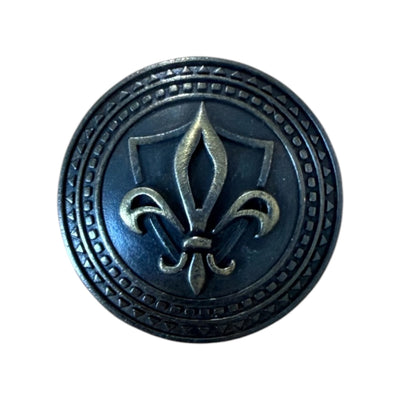
Blazer buttons are the fastest and cheapest way to change the character of a jacket. A navy jacket with plastic buttons reads as half of a suit; the same jacket with crested metal buttons instantly becomes a classic club blazer. This guide covers how many buttons a set contains, which sizes are correct, how to choose between gold, silver and gunmetal, and how to swap the buttons yourself without damaging the cloth.
Where metal blazer buttons come from
The navy blazer descends from the jacket worn by British naval officers, which was fastened with gilt metal buttons. That heritage explains the motifs you still see most often: anchors, crowns, heraldic crests, rope borders or a plain domed face. Traditionally, blazer buttons were made from mother of pearl, silver, pewter, brass or gilt metal. Today most are brass or zinc alloy with an electroplated finish, which gives a consistent colour at a sensible weight.
It is worth separating the blazer from the suit jacket. A suit has matching trousers and usually wears buttons that blend into the cloth, such as horn, corozo or polyester. A blazer is a standalone garment and its buttons are a deliberate accent. That is exactly why metal belongs here and not on a business suit.
 Gold buttons MC 2110 Col E109 – 22 mm with crest for suits and coats
 MC 1772 crest metal buttons – Gun Metal 20 mm with shank for suits and jackets
 Metal coat of arms buttons 6-Z538 Col 292 – Gun Metal 22 mm with shank
How many buttons are in a blazer set?
A set always contains two sizes: large buttons for the front and small ones for the cuffs. The count depends on the cut.
| Cut | Front (large) | Cuffs (small) | Total + spares |
|---|---|---|---|
| Single-breasted, 2 buttons | 2 | 6–8 (3–4 per cuff) | 8–10 + 1 large, 1 small |
| Single-breasted, 3 buttons | 3 | 6–8 | 9–11 + spares |
| Double-breasted 6x2 | 6 | 6–8 | 12–14 + spares |
| Double-breasted 6x1 or 4x1 | 4–6 | 6–8 | 10–14 + spares |
On double-breasted jackets some of the front buttons are purely decorative, but they are still bought in the large size. Many tailors also put a small button on the inside pocket, so if your jacket has one, add another small button to the order.
Tip: always buy at least one spare of each size. Metal buttons are often produced in runs, and a year later the exact same finish may no longer be available.
Sizes: millimetres and ligne
In tailoring, button size is given either in millimetres or in ligne (L). One ligne is 0.635 mm, so 40 ligne equals one inch (25.4 mm). That is why catalogues show figures such as 32L or 24L.
- Blazer front: 20–22 mm (32–36L). 20 mm suits narrower lapels and smaller frames; 22 mm is the classic size for a men's blazer.
- Cuffs: 15 mm (24L) is the standard, with some makers using 14–16 mm.
- Double-breasted coats and pea coats: 25–28 mm (40–44L).
Historic naval gilt buttons were also made in a handful of fixed sizes, namely 40, 35, 28 and 22.5 ligne, which shows the large-front, small-cuff logic is as old as the garment itself. Before ordering, measure your existing buttonhole: the button should be 1–2 mm smaller than the opening so it passes through easily but does not slip undone on its own.
Gold, silver or gunmetal?
Gold and antique brass
The classic choice for a navy blazer. Bright gilt looks the most formal and nautical; antique brass is more muted and works beautifully on tweed, camel and olive cloth. Gold pairs naturally with brown shoes and a brown belt.
Silver, antique silver and pewter
A quieter, more contemporary option. Silver-tone buttons suit grey, black and very dark navy blazers, and match a steel watch. Antique silver with a crest is a good compromise for anyone who finds gold too loud.
Gunmetal and black oxide
Dark finishes give you the sheen of metal without strong contrast. They work well on black and charcoal blazers and on minimalist womenswear jackets.
The simple rule: keep the button metal in step with your other hardware, such as belt buckle, watch case and any metal details on your shoes.
Crest, anchor or plain?
Crested and anchor buttons are the most recognisable blazer look. If the jacket will be worn in a business setting, a plain domed or finely engraved button is the safer choice. Clubs, schools, hotels and restaurants often commission buttons with their own logo, in which case the brand itself is the motif. Read more about the techniques in our articles on trim manufacturing.
Shank or holes?
Almost all metal blazer buttons have a shank, a small loop underneath. The shank lifts the button above the cloth so that a thick wool front does not pucker around it. Metal buttons with sew-through holes are rare on jackets and much more common on shirts.
How to replace blazer buttons, step by step
- Mark the position. Before removing the old buttons, place a pin or a fabric-marker dot exactly where the centre of each one sits.
- Remove the old buttons carefully. Cut the thread under the button with small scissors or a seam ripper, keeping the blade away from the cloth.
- Choose strong thread. For shank buttons use polyester or silk thread, doubled. See our sewing threads.
- Sew with a thread neck. On front buttons leave 2–3 mm of slack between the shank and the cloth and wrap it several times with thread. This lets the button sit flat in the buttonhole.
- Cuffs. Cuff buttons are sewn close together, with edges touching or slightly overlapping ("kissing" buttons are a classic detail), and without a neck if the buttonholes are decorative.
- Secure the thread inside with a few tiny stitches and trim.
FAQ
Can I put metal buttons on a suit jacket?
Technically yes, but the jacket will no longer look right with its matching trousers. If you want to wear the jacket on its own, metal buttons are a great way to give it a second life.
Are metal buttons heavy?
Solid brass is heavier, but most modern designs are hollow or made of light alloy, so you will not feel a difference when wearing the jacket.
Can they cause skin allergies?
Jacket buttons rarely stay in prolonged contact with skin, but if it matters to you, choose models marked Nickel Free.
Where to get a set
Our buttons collection includes crested, gunmetal and antique brass metal buttons from 15 to 25 mm, and for outerwear there are larger designs in coat buttons. If you are a brand or atelier looking for buttons with your own crest or logo for a run of blazers, get in touch, as Bul-tex accepts custom orders. We ship with DHL Express across the EU.