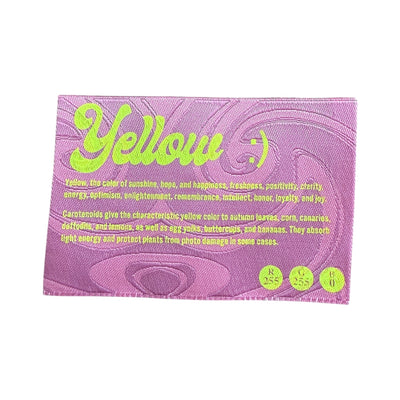
The woven labels minimum order, or MOQ (minimum order quantity), is the first hurdle small brands and ateliers run into: you need 150 labels for your first collection and the manufacturer talks about 1,000. That isn't a whim; it follows directly from how a jacquard loom works. In this article we separate the myths from the facts about MOQ for woven labels and give concrete strategies for ordering a sensible quantity as a small brand without paying for things you don't need.
Why a minimum order exists at all
A woven label is woven on a jacquard loom as a long ribbon in which your design repeats. Before the first usable label comes off the machine, a fair amount of work has to happen:
- the artwork is converted into a weaving file that tells the loom which yarn surfaces where;
- the loom is loaded with the coloured yarns for your label;
- test lengths are run to check density, colour and the legibility of small text;
- after weaving, the ribbon is cut, folded and packed.
The first three steps take almost the same time whether we weave 300 or 3,000 pieces. That is a fixed cost. On a small run it is spread over very few labels and the unit price becomes disproportionately high. An MOQ is how a manufacturer makes sure the set-up makes sense for both sides.
 Woven label 8 cm x 3 cm - brand and logo
 Jacquard woven label LBL 0030 6 x 3 cm – black style with white letters, soft premium design, with logo
 Woven label 5 cm x 5 cm – logo for brands
Typical minimums in the industry
Minimums vary between manufacturers, but there are clear benchmarks. Some start at 500 pieces; most start at 1,000 pieces per design. For very small labels the minimum can be considerably higher, because a metre of ribbon yields many pieces and the loom has to run longer to justify the set-up. In the Bul-tex catalogue, custom woven jacquard and printed labels have a minimum of 1,000 pieces, while some metal labels for laser branding are available from 100 pieces.
MOQ myths and facts
Myth: "The manufacturer sets a high minimum just to sell more."
Fact: the minimum covers the real machine set-up. Below a certain run the manufacturer can't recover the preparation time, and the unit price becomes unreasonable for the customer.
Myth: "If I order 1,000 I'll be stuck with 800 spare labels."
Fact: if the label carries your main brand and no season or year, it will be used in the next collections too. Labels don't spoil, and storing them takes one box.
Myth: "Five designs of 200 pieces is the same as 1,000 pieces."
Fact: to the loom these are five separate set-ups. The minimum normally applies to one design, one size and one colour combination.
Myth: "Printed labels have no minimum."
Fact: printing has set-up too: plates, ribbons, colour calibration. Printed labels also have minimums, although they are sometimes more flexible for small formats.
How a small brand can order smart
1. One main label for every style
The most efficient strategy is one logo label sewn into every garment. Sizes (S, M, L) and composition go on a separate small label. That way 1,000 main labels cover several collections, not a single style.
2. A standard size and format
Pick a proven size, for example 50 x 20 mm or 60 x 25 mm, with a straight cut or centre fold. Unusual shapes and complex folds add operations and make a small run even more expensive.
3. Fewer colours
Two or three yarns plus the background give a clean, legible label and a simpler set-up. Gradients can't be woven anyway.
4. Combine your purchasing
If you work with an atelier or another small brand, it is sometimes possible to align your orders for other trims, such as buttons, zippers and elastics, to save on shipping and time. Your logo label still remains a separate design, though.
5. Consider ready-made labels and trims
For samples and a first small run you can use ready solutions, such as metal labels with a low minimum that are laser-engraved, or tagging pins and accessories from stock, and order the woven label once sales confirm the style.
Practical tip: when you calculate how many labels you need, add 3-5% for sewing waste, samples and photo shoots. Running out of labels three garments before the end of a run costs far more than a few spare pieces.
Quick reference table
| Situation | Recommendation |
|---|---|
| First collection, 100-300 garments | One main label of 1,000 pieces for several seasons; size and composition on a separate label |
| Samples and test styles | A laser-engraved metal label or a temporary solution until the style is confirmed |
| Several lines under one brand | One brand design; separate the lines with the size label or a hang tag |
| Growing brand with repeat orders | A larger run at once: lower unit price and no waiting before every collection |
Frequently asked questions
Does the minimum apply to each colourway separately?
Usually yes. A different colour combination means reloading the yarns. If you want a dark and a light version, plan them as two separate designs.
Can I order fewer at a higher price?
It depends on the format and how busy production is. The best approach is to describe your project and ask; sometimes there is a solution with a similar format or a different technique.
How long can labels be kept in stock?
Polyester woven labels are a stable material. Stored dry and away from direct sunlight, they keep their appearance for a long time.
Bul-tex manufactures labels for clothing brands and helps small producers find a sensible format for their first order. Browse the woven and printed labels in our catalogue, read more production guides, and get in touch with your artwork and planned quantity. We'll suggest the most cost-effective option.