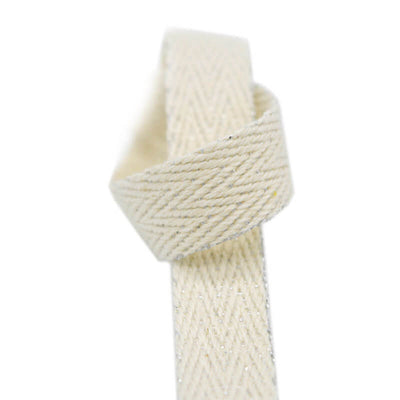
Cotton twill tape, also called herringbone tape, is a strong woven tape with a distinctive diagonal zigzag pattern and almost no stretch along its length. It is one of the most useful notions a sewist can keep in the drawer: it stabilises seams, keeps shoulders and necklines from stretching, and becomes apron ties, drawstrings or hanging loops. Here is what it is used for and how to work with it.
What is herringbone twill tape?
The name comes from the weave: the threads run diagonally and form a zigzag that resembles a fish skeleton. This structure gives a dense tape that is flexible across its width but stable along its length. The herringbone tapes at Bul-tex are 100% cotton, available in 0.6, 1, 1.5, 2, 2.5, 3, 3.5, 4 and 5 cm widths and in 17 colours, from white, ecru and beige to navy, red, green and black.
- does not stretch lengthwise;
- tolerates a hot iron;
- is easy to sew by machine or by hand;
- has a natural, matte, utilitarian look.
 Cotton herringbone tape white HR0001
 Cotton herringbone tape ecru HR0002
 Cotton herringbone tape beige HR0003
8 practical uses
- Shoulder stabilising – 0.6–1 cm tape sewn into the shoulder seam of knit tops so they do not sag.
- Neckline and armhole stay tape – stops bias-cut edges from stretching as you sew.
- Apron ties – 2–2.5 cm for the neck and waist; they look good and survive countless washes.
- Drawstring bags – 1–1.5 cm tape threaded through the casing instead of cord.
- Hanging loops – on coats, bath towels, tea towels and jackets (1 cm is plenty).
- Binding inner seams – gives a clean finish to unlined jackets and bags.
- Tote bag handles – 3–4 cm tape, folded and edge-stitched.
- Bunting and garlands – triangular flags sewn onto 1.5–2.5 cm tape.
Which width to choose
The rule is simple: the more load the tape has to carry, the wider it should be. For invisible stabilising inside a garment, pick the narrowest width in a colour close to the fabric; for visible ties and handles, a contrasting colour makes a nice accent.
| Width | Typical use |
|---|---|
| 0.6–1 cm | Seam stabilising, loops, small ties |
| 1.5–2 cm | Drawstring bags, bunting, marking tags |
| 2.5–3 cm | Apron ties, trims |
| 3.5–5 cm | Bag handles, belts, straps |
How to sew and care for cotton tape
Pre-wash it. Cotton can shrink slightly in the first wash. If the tape will stabilise a garment seam, wash it or steam it with the iron before sewing so it does not pucker the seam later.
Sewing: to stabilise a shoulder, lay the tape over the seam line on the wrong side and stitch it in with the seam. For ties, double-fold the ends by 0.5–1 cm and stitch a box or an "X" for extra strength. Use a 80/12–90/14 needle and strong cotton or polyester thread.
Washing and ironing: light colours can take 40–60°C, while darker shades are best washed at 30–40°C. Iron on the hot cotton setting.
Frequently asked questions
What is the difference between herringbone tape and webbing?
Herringbone tape is thinner and softer, ideal for clothing and decoration. Webbing is thicker and stiffer, made for load-bearing parts like backpack straps and belts.
Can twill tape replace bias binding?
On straight edges, yes. On curved edges bias binding is better because it is cut on the diagonal and bends around curves.
Does cotton twill tape shrink?
It may shrink a little on the first wash, so pre-wash it if you are sewing it onto a finished garment.
Choose your colour and width in our ribbon collection, and for drawstrings and ties take a look at our accessories such as cord stoppers and aglets.