Hang tag size looks like a minor detail – until the barcode doesn't fit, the logo is squashed into a corner, or the tag sticks out awkwardly from a T-shirt collar. The right size depends on the garment, how much information you need to carry and how many tags fit on a printed sheet. Below is a reference table of standard sizes in millimetres, plus practical advice on choosing.
Reference table: standard sizes
| Format | Typical size (mm) | Best for | Information capacity |
|---|---|---|---|
| Classic rectangle | 50 × 90 | T-shirts, shirts, dresses, trousers | Logo on the front; price, size, barcode, composition on the back |
| Compact | 45 × 75 or 48 × 60 | Basics, knitwear, underwear | Logo plus price and size; barcode on a sticker |
| Slim strip | 35 × 100 or 40 × 120 | Jeans, trousers, contemporary brands | Vertical logo; good for longer copy |
| Square | 50 × 50 or 60 × 60 | Knitwear, kidswear, hats | Logo and a short line; barcode on the back |
| Small accessory | 30 × 50 or 38 × 75 | Jewellery, belts, socks, scarves | Logo and price |
| Large | 60 × 110 or 70 × 120 | Coats, jackets, premium denim | Brand story, technical details |
| Folded (booklet) | 50 × 90 folded (100 × 90 flat) | Premium and gift ranges | Four panels for story and instructions |
The most common apparel format is around 50 × 90 mm – roughly business-card size (about 2 × 3.5 in). Smaller formats of around 38 × 75 mm are used for accessories and jewellery.
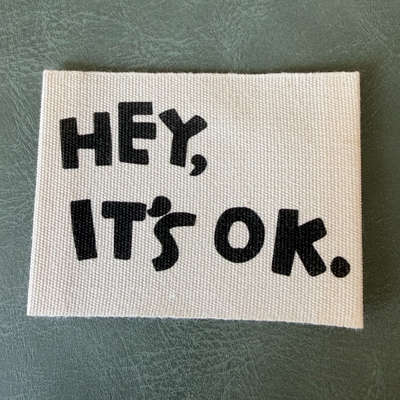
 Printed canvas label LBL 0067 5.5 x 4 cm – with black letters, soft premium design, with logo
 Woven label 10 cm x 7 cm – print on fabric
 Jacquard woven label LBL 0046 5 x 5 cm – black background with gold letters, premium design, soft style, with logo
Which size for which garment
T-shirts and basic jersey
45 × 75 or 50 × 90 mm. The tag usually hangs from the collar or underarm and shouldn't be heavy enough to drag thin jersey.
Jeans and trousers
A slim 40 × 100–120 mm strip or a large 60 × 110 mm tag. Jeans often carry a second branding element, such as a leather or card patch on the waistband, so a slim tag complements it without overlapping. It pairs well with metal buttons and rivets in the same finish.
Knitwear
Square, 50 × 50 or 60 × 60 mm. Attach it through the seam label rather than the knit, so you don't distort the loops.
Coats and jackets
60 × 110 mm and up, or a folded tag. A bigger garment carries a bigger tag well, and buyers expect more information – filling, water resistance and so on.
Kidswear
Small squares or 45 × 75 mm with rounded corners. Fewer sharp edges, less risk during try-ons.
Accessories
30 × 50 to 38 × 75 mm. A slim vertical tag for scarves and belts; the smallest format, often on a narrow ribbon, for jewellery.
How size affects cost
Hang tags are printed on large sheets – for example SRA3 at 320 × 450 mm, or bigger offset formats – and then trimmed. The unit price depends mostly on how many tags you get per sheet.
- At 50 × 90 mm with trim margins, an SRA3 sheet yields roughly 20–24 tags.
- At 60 × 110 mm, around 15–18.
- At 40 × 60 mm, more than 40.
So even 5 mm can change the yield per sheet and your cost per thousand. Ask your manufacturer which size is optimal for their sheet – a tiny tweak often saves money with no visible difference.
Tip: a plain rectangle is guillotine-cut, which is cheaper and faster. Rounded corners, custom shapes and windows need a cutting die – an extra cost on the first order.
What needs to fit
Before you pick a size, list everything the tag must carry:
- Logo and brand name
- Price, or space for a price sticker
- Size and colour
- An EAN-13 barcode – about 37 × 26 mm at nominal size, plus blank quiet zones on either side
- Style number (SKU)
- Website, QR code, social handles
The barcode often sets the minimum size: an EAN-13 fits on the back of a 45 × 75 mm tag, but leaves little room for anything else. If you want a QR code and copy as well, go for at least 50 × 90 mm.
Portrait or landscape?
Most tags hang in portrait because that's easiest to read while the garment is on a hanger. Landscape works when garments are folded on a shelf – stacked tees and jumpers, for example. Think about how shoppers will see the product in store or in your online photos: if garments are shot flat, a landscape tag with a clear logo often looks better.
Placement matters too. A tag on the sleeve can be larger, while one on a T-shirt collar should stay compact so it doesn't flip the collar or show on a mannequin.
Hole, eyelet and string
The hole is usually 3–5 mm in diameter, centred and about 8–10 mm from the top edge. On a slim tag it can sit in the top left corner. A metal eyelet reinforces the hole and adds a finished look. To attach the tag, use hang tag strings or a narrow satin or grosgrain ribbon.
FAQ
Is there a mandatory hang tag size?
No. EU rules don't set a size for hang tags. Mandatory information such as fibre composition has to be on a durably attached label on the garment itself.
Can I use one size for the whole collection?
Yes, and it's the most economical approach – one cutting die, one design, a bigger run. Vary only the information on the back.
What size should I start with?
50 × 90 mm, 350 gsm, printed both sides. It's versatile, looks professional and suits almost any garment.
Bul-tex manufactures and supplies garment trims and accepts custom orders for brands. For hang tags in a non-standard size or shape, get in touch. You'll find more practical guides in our labels section.