What do custom metal buttons cost? It is the first question every brand asks, and the only honest answer is "it depends". But on what, exactly? This article breaks the price of a custom metal button into its components: mould, alloy, size, plating, logo technique, quantity and packaging. You will see how each factor moves the number and how to bring the price down without compromising the look.
The two parts of every price
Any quote for custom hardware consists of two parts:
- One-off costs: mould, die, technical drawing and samples. Paid once, regardless of quantity.
- Unit price: material, processing, plating, inspection and packing. Multiplied by quantity.
That is why the unit price at small quantities looks high: one-off costs are spread over very few pieces.
 Metal buttons with logo 0076 Col 101926 – 18 mm with matte grey finish
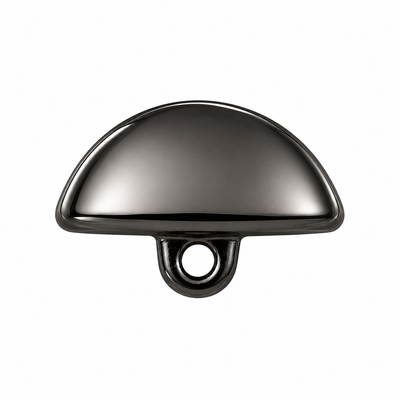
 MC 1772 crest metal buttons – Gun Metal 20 mm with shank for suits and jackets
 Gold brass metal buttons 7-M020 Col 406 – 20 mm for designer clothing
Factor 1: The mould
A cast logo button needs a steel mould. According to international manufacturers, the mould fee for a metal button is in the region of 60–80 EUR and is usually not charged again on repeat orders. Complex 3D motifs, multiple relief levels or multi-cavity moulds for faster production cost more. Stamped buttons (jeans buttons, snaps, eyelets) need a die instead; for an embossed logo the typical setup cost is around 130–150 EUR.
Here is how an 80 EUR mould spreads across different quantities:
| Quantity | Mould share per piece |
|---|---|
| 300 pcs | ≈ 0.27 EUR |
| 1,000 pcs | ≈ 0.08 EUR |
| 5,000 pcs | ≈ 0.016 EUR |
| Repeat order | 0 EUR |
It is simple arithmetic, but it shows clearly why a brand that will reorder should treat the mould as an investment rather than a cost charged to one run.
Factor 2: The alloy
Zinc alloy (zamak) is the most common material for cast buttons: it casts easily into detailed shapes and is cheaper. Brass is more expensive than zinc alloy but resists corrosion better and has a more premium weight and feel; it is the standard for jeans buttons, eyelets and snaps. Stainless steel and aluminium are used for specific needs: steel for high durability, aluminium for lightweight designs.
Factor 3: Size and weight
More metal means higher material cost and longer time in the plating bath. A 25 mm coat button costs more than a 15 mm cuff button of the same design. Hollow buttons and shank-backed designs instead of solid backs save material. With stamped buttons, size matters less because the sheet metal is thin.
Factor 4: Plating and finish
Finishing is often a surprisingly large share of the price:
- Nickel, bright gold: the simplest processes.
- Antique brass, antique silver: extra darkening plus hand or machine polishing of the high points.
- Two-tone finishes: masking and two baths.
- Enamel: manual or semi-automatic filling, curing and a higher reject rate.
- Nickel-free: an alternative plating chemistry, required for jeans buttons and hardware in skin contact.
- Lacquer, soft-touch, rubberised coatings: an additional step.
Factor 5: Logo technique
| Technique | One-off cost | Unit price | Best value at |
|---|---|---|---|
| Laser engraving | None | Low (a few euro cents) | Small runs, tests |
| Stamped emboss/deboss | Die | Very low | Above ~500 pcs |
| Cast relief | Mould | Medium | Medium and large runs, premium look |
| Enamel | Mould + colours | Higher | When brand colour matters |
Example: on 300 buttons, laser engraving adds only a few euros to the whole order, while a die costs over a hundred. At 5,000 pieces the maths flips.
Factor 6: Quantity
Beyond spreading the mould, quantity also lowers the unit price itself: a bigger run means better machine utilisation, a fuller plating bath and less setup time per piece. Manufacturers usually have price breaks, for example at 500, 1,000, 3,000 and 5,000 pieces. The industry minimum for custom metal buttons is typically around 100 pieces per design and size.
Factor 7: Packaging and logistics
Bulk packing in counted bags is the cheapest. Buttons sewn onto branded cards, individual boxes or per-garment kits (for example 2 large + 6 small) add cost, which is justified if the buttons are sold as spares or in gift packaging.
Three scenarios: 300, 1,000 and 5,000 pieces
300 pieces: a small brand's first collection
One-off costs weigh the most here. If the logo is simple, laser engraving on a stock button is the sensible start: no mould, and a clean, modern look. If relief matters to you, choose one size and one finish so you only pay for one mould.
1,000 pieces: a brand with repeat styles
The mould now spreads well and a cast button with a raised logo becomes realistic. This is the moment to consider a second size, for the cuff or a pocket, in the same design.
5,000 pieces: uniforms, corporate wear, larger brands
The mould share is negligible and the unit price is driven mainly by alloy, size and finish. This is where it pays to negotiate on plating, per-garment kit packing and staggered deliveries.
How to bring the price down
- One design, two sizes instead of two different designs, so the moulds are made together at similar cost.
- One finish for the whole collection.
- Simplify the logo: fewer relief levels and fewer enamel colours.
- Plan repeats: the mould pays for itself and later orders carry no setup cost.
- Bundle your hardware: button, eyelet and snap with one logo from one manufacturer often give a better overall price.
- Test with laser before investing in a mould.
Tip: when comparing quotes, compare the total for the whole order, including mould, samples and delivery, not just the unit price.
Request a quote
Bul-tex manufactures and supplies garment trims and accepts orders for logo metal buttons, snap fasteners and eyelets. For an accurate price we need size, quantity, finish and your logo; send them via the contact page. If the budget does not stretch to a custom order, browse the stock designs in our buttons collection. Read more about the process from brief to delivery in our manufacturing articles.