Woven labels cost is one of the first things every new clothing brand asks about, and the honest answer usually starts with "it depends". That isn't evasion: the same logo label can vary a lot per piece depending on its size, the number of colours, the weave quality, the fold and, above all, the quantity. This buyer's guide walks through each price driver, explains why it matters, and shows how to make choices that protect quality without overpaying.
How the price is built: fixed and variable costs
Every woven label order has two parts. The first is fixed costs: preparing your artwork for weaving (programming the file), setting up the loom, loading the coloured yarns and running test lengths. These are the same whether you order 1,000 or 10,000 pieces. The second is variable costs: yarn, machine time, cutting, folding and packing, which grow in line with the run length.
That is why the fixed part weighs heavily on each label in a small order, while in a large run it is spread across thousands of pieces and the unit price drops noticeably. It is also the main reason manufacturers work with a minimum order quantity. In our catalogue, custom woven and printed labels are generally ordered from 1,000 pieces upwards.
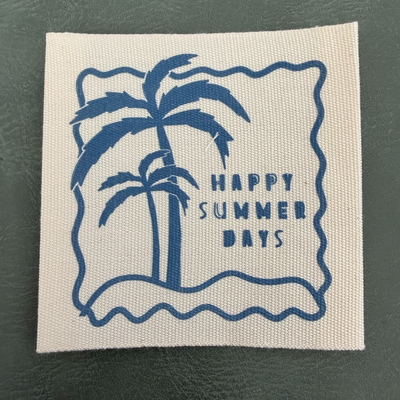
 Printed canvas label LBL 0068 6 x 6 cm – with blue print, soft premium design, with logo
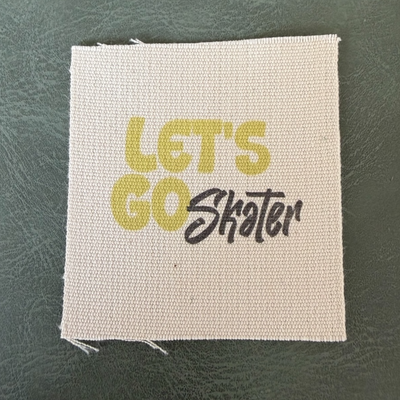
 Printed canvas label LBL 0073 5 x 4.5 cm – with color print, soft premium design, with logo
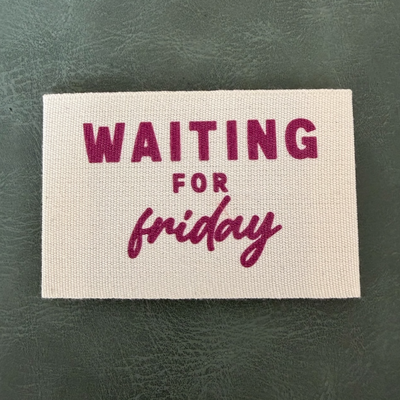
 Printed canvas label LBL 0065 6.5 x 4 cm – with purple lettering, soft premium design, with logo
The main price drivers at a glance
| Factor | Pushes the price up | Brings the price down |
|---|---|---|
| Size | Large labels, e.g. 70 x 40 mm and above | Compact labels around 40-50 mm long |
| Number of colours | 5-8 colours, subtle shades | 2-3 colours with clear contrast |
| Weave type | High-density satin, very fine detail | Standard damask with a clean design |
| Cut and fold | Ultrasonic cut, centre fold, mitre fold | Straight cut, no fold |
| Extra finishing | Iron-on backing, individual numbering | No backing, single design |
| Quantity | Minimum run, many designs in one order | Larger run, one shared design |
1. Label size
A woven label is produced as a continuous ribbon in which your design repeats. The longer each label, the fewer pieces you get from a metre of ribbon and the more machine time each piece consumes. The difference between a 50 x 20 mm and an 80 x 30 mm label shows up clearly in the quote, and it is often unnecessary: a logo and brand name read perfectly well on a smaller area. Before you choose a size, check exactly where the label will be sewn and how much space there really is at the back neck or side seam.
2. Number of colours
In weaving, every colour is a separate yarn that has to be loaded on the loom. Most standard labels use two to four colours plus the background. Each extra colour adds set-up complexity and sometimes thickness. If your logo relies on gradients or many shades, it is usually cheaper, and frankly better looking, to simplify it to a few solid colours, because weaving cannot reproduce smooth transitions the way print can.
3. Weave type: damask, satin, taffeta
Damask is the go-to choice for most brands: it is woven from fine polyester yarn at high density, feels soft and holds detail well. Satin has a glossy, smooth face and feels lovely against the skin, though fine detail is more limited. Taffeta is the most economical but also the stiffest, so it suits labels that don't sit directly against the body. The weave affects both the price and how comfortable the garment feels to your customer, so don't judge on the number alone.
4. Cutting and folding
A straight hot-knife cut is the fastest and cheapest finish. An ultrasonic cut seals the edge softly and prevents a scratchy border; it costs a little more but dramatically reduces complaints about labels that itch. Folding adds another operation too: a centre fold for inserting into a seam, end folds, or a mitre fold for hanging in the neck seam. Each fold is an extra step, but it also changes how the label looks and how easily it is sewn.
5. Quantity and number of designs
Quantity is the strongest lever on the unit price. If one order contains five different designs of 200 pieces each, the manufacturer sees five separate set-ups, so the price will look more like five small orders than one order of 1,000. The reverse also holds: one versatile main brand label for the whole collection, combined with separate size labels, is the most efficient strategy for small and mid-sized brands.
Tip: if you plan several collections a year, order your main brand label in a larger quantity at once. Labels don't go out of date as long as the design carries no season or year, and the unit price falls considerably on a longer run.
Hidden costs people forget
- Repeated artwork corrections: supply a vector logo (AI, PDF, SVG) from the start to avoid extra proof rounds.
- Wrong size: a label that doesn't fit the seam means a reorder. Measure on a real garment.
- No spare stock: order 3-5% more than your garment count to cover sewing waste and samples.
- Rush orders: ordering at the last minute can mean pricier shipping or compromises on quality.
- Forgetting the care label: under Regulation (EU) No 1007/2011 fibre composition is mandatory, so budget for a separate composition and care label with ISO 3758 symbols.
How to get an accurate quote
To give you an exact price, a manufacturer needs a few details. Have them ready and the quote will be quick and free of surprises:
- Your logo or artwork in vector format.
- Target size in millimetres (width x length) and where it will be sewn.
- Number of colours and preferred weave or print.
- Cut and fold type.
- Quantity, and whether there are several design variants.
- Required delivery date.
Bul-tex manufactures and supplies labels for clothing brands: woven jacquard labels, printed canvas and satin labels, plus metal labels – stock E-series for laser branding, or custom shapes with a moulded relief logo. Browse the formats in the label collection, then request a quote for your design. We'll tell you which parameters to adjust to reach your target price without compromising how your brand looks.
Frequently asked questions
Why are small quantities so much more expensive per piece?
Because of the fixed costs for file preparation and loom set-up. They are spread over fewer pieces, so each label carries a bigger share of them.
Is a printed label cheaper than a woven one?
Often yes, especially with many colours or photographic detail that weaving can't reproduce. A woven label, however, looks more premium and stands up better to washing. You'll find more on the differences in our label guides.
Can I save by ordering labels for several styles at once?
Yes, if you use one shared brand design. Sizes and compositions are better handled with a small separate label rather than a different main label for every style.