Metal button finishes can change the character of a garment more than the button shape itself: the same blazer reads sporty in gunmetal, classic in antique brass and festive in light gold. The trade names are confusing, though. Nickel, gunmetal, black oxide, light gold, antique silver: what is the difference? This glossary explains what each finish looks like, how it is produced and which fabrics and colours it pairs with best.
How a metal button gets its colour
Nearly every metal button, eyelet, buckle or rivet is electroplated. The base metal (zinc alloy, brass or steel) is coated with several metal layers in electrolytic baths, and the top layer sets the colour. There are three main approaches:
- Bright finish: a polished base and a shiny top layer.
- Matte or brushed: the surface is textured before or after plating so it scatters light.
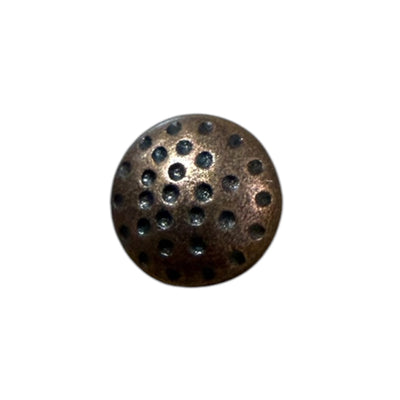
- Antique (patinated): the whole button is chemically darkened, then the raised areas are brushed back, leaving dark recesses and bright high points.
Finally, a lacquer (or wax for some antique effects) is almost always applied to lock in the colour.
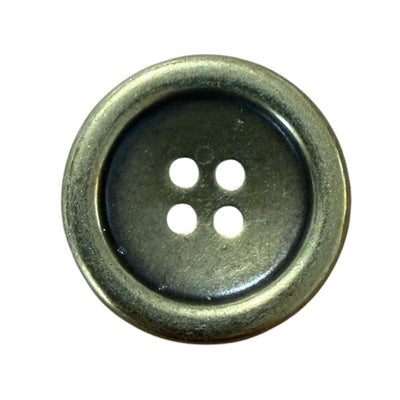
 Shank buttons 23972 – Gun Metal 22 mm
 Designer luxury metal buttons C458 – Antique brass 22 mm
 Gold metal buttons 0555 Col 0019 – Light Gold 22 mm
Finish glossary
Bright nickel
A bright, cool silver with a mirror shine. A versatile choice for shirts, workwear and sportswear. Note that it contains nickel, so for parts in prolonged skin contact choose a nickel-free alternative.
Matte (satin) nickel
The same tone, softened and glare-free. It looks modern and technical, and suits minimalist jackets, bags and light-wash denim.
Gold
A rich yellow tone that may be brass, a gold-coloured plating or a thin gold layer over nickel. The traditional choice for blazers, uniforms and nautical styling.
Light gold
A paler, champagne gold. Subtler than classic gold and lovely on beige, ecru, pastels and powder tones.
Antique brass
Dark recesses and bright high points over a warm brass base. The standard for denim, leather jackets and vintage-inspired collections, and it brings out every detail of a crest or relief.
Antique silver and antique copper
The same patination principle over a silver or copper tone. Antique silver looks great on grey, black and navy; antique copper on brown, khaki and camel.
Gunmetal
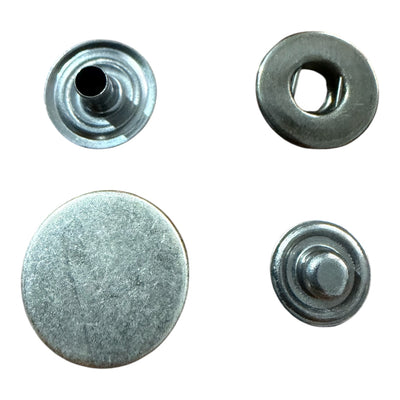
An even, shiny blue-grey to near-black tone with silvery highlights, usually sealed with clear lacquer. It is the most versatile dark metal, working with black, charcoal, navy and almost any saturated colour, and is popular on coats, suits and snap fasteners.
Black nickel and black oxide
Black nickel is a dark, slightly glossy electroplate. Black oxide is a conversion coating with a flatter, almost graphite black. Both give a discreet, elegant look without the flash of classic metal.
Matte black and soft-touch
Here the colour comes from paint or lacquer rather than metal. Soft-touch has a velvety, slightly rubberised feel and can be tinted almost any shade, from navy to ecru to burgundy. Use it when you want the button to blend with the fabric.
Which finish with which fabric
| Finish | Fabrics and colours | Look |
|---|---|---|
| Bright nickel | White, blue, grey; cotton, poplin | Clean, sporty |
| Matte nickel | Light denim, nylon, technical fabrics | Modern, minimal |
| Gold | Navy, white, red; wool | Classic, nautical |
| Light gold | Beige, ecru, pastels; linen, silk | Delicate, feminine |
| Antique brass | Indigo denim, brown leather, khaki | Vintage, workwear |
| Antique silver | Grey, black, navy | Understated, rock |
| Gunmetal | Black, charcoal, saturated colours | Versatile, urban |
| Black oxide | Black, dark wools | Discreet, luxurious |
| Soft-touch | Tone-on-tone with the fabric | Low-key, modern |
Match every metal part on the garment
One garment can carry buttons, eyelets, rivets, buckles and a zip. If they come from different suppliers, one supplier's gunmetal may be visibly lighter than another's. So:
- Pick one reference finish and request samples of every metal component.
- Compare them side by side, in daylight, on the actual fabric.
- Remember that bright and matte versions of the same finish look different, and decide which you want throughout.
- Record the colour code (for example Col 130 or Col 2586) for future reorders.
Tip: antique effects are hand-brushed and can vary slightly between batches. If the colour is critical, order the full quantity in one go.
How durable are the finishes?
Bright finishes show scratches more readily, while matte and antique finishes hide them. Lacquer adds protection but can wear off under aggressive laundering such as stone or enzyme washes. For denim, antique brass and gunmetal remain the most dependable because wear looks natural on them.
Choosing a finish for a whole collection
If your collection runs to 10–20 styles, they don't each need a different metal. A practical approach is to pick one core finish for the season, say gunmetal or antique brass, and one accent finish for a few hero pieces, such as light gold. You then order larger quantities of fewer items, the colour matches across buttons, eyelets and buckles, and the brand look stays recognisable. For core lines that repeat every season, choose a finish you can reorder without change: standard colours from the range are a safer bet than special effects.
FAQ
What is the difference between antique brass and old gold?
In practice they are two names for the same effect, a patinated brass surface with dark recesses. Shades vary between suppliers, though, so always compare samples.
Is gunmetal black?
Not quite. Gunmetal is a dark grey with a bluish cast and a metallic sheen. If you want true black, choose black oxide, black nickel or matte black.
Which finish shows wear the least?
Antique and matte finishes, because scratches blend into the texture. Bright nickel and gold show wear most clearly.
See the finishes on real products in our metal buttons, snap fasteners, eyelets and buckles. Need one finish across a whole collection? Bul-tex takes trim orders to specification, so get in touch.