Rings for clothing and bags are among the most versatile sewing accessories – they connect belts, straps, handles and decorative ties. Choosing one looks easy until the ring turns out too narrow for the webbing or the metal tarnishes after a month. Here are the main ring types, what each shape is for and how to pick the right size.
O-rings (round rings)
Round rings are the classic shape. They let a strap or tab pivot freely in every direction, which is why they are used to join straps, on key fobs, dress belts and decorative sleeve details. You'll find flat rings with a flat cross-section and round-wire rings with a rounded profile. Flat rings look more modern and sit closer to the fabric, while round-wire rings are better for cords and ties.
 Plastic bra sliders and rings
 Metal rings E-2315 Nickel – Buckle type, Oval model with beads – 2.5 cm
 Metal ring and slider R&R – 8 mm bronze set
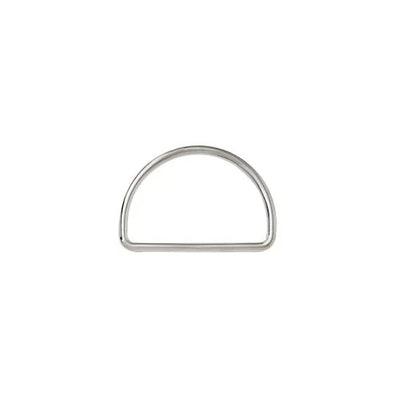
D-rings and half rings
D-rings have one straight side and one curved side. The straight side keeps the strap flat without bunching, while the curved side takes a snap hook or another strap. That makes them ideal for:
- double D-ring belts, where the strap passes through both rings and tightens without a buckle;
- attaching handles and shoulder straps to bags and backpacks;
- belts on trench coats, jackets and dresses;
- key straps and small accessories.
Rectangle rings
Rectangle rings keep wide straps perfectly flat and give a clean, architectural look. They are used on fabric belts, bag and holdall straps and as a decorative detail on coats. Their inner width should match the strap exactly – for example a 40 mm ring for 40 mm webbing.
Metal or polyester rings?
Metal rings are strong and handle load well, so they suit bags and belts. Pay attention to the finish: Gun Metal, gold, light gold and nickel each create a different look, and a nickel-free label matters for pieces worn against the skin. Polyester rings are lightweight, never rust and keep their shape, making them practical for dresses, swimwear and summer clothing where metal would feel heavy or react with chlorine and salt water.
How to choose the size
Ring size refers to the inner width – the part the strap passes through. It should equal the strap width or be 1–2 mm larger.
| Inner size | Typical use |
|---|---|
| 7–10 mm | lingerie, swimwear, thin straps |
| 15–20 mm | tabs, dress belts, sleeve details |
| 25–30 mm | fabric belts, bag shoulder straps |
| 40 mm and up | wide belts, backpacks, holdalls, statement details |
If the ring will carry weight, such as a bag handle, choose a thicker wire or a welded ring – open designs are mostly decorative.
Frequently asked questions
What is the difference between a ring and a buckle?
A buckle has a prong or mechanism that locks the strap at a set length. A ring is a closed loop with no mechanism – the strap is either stitched in place or held by friction, as on a double D-ring belt.
How do I sew a strap to a ring?
Pass the strap through the ring, fold it back 2–3 cm and stitch a box with a cross in the middle. This spreads the load evenly across the seam.
Are metal rings suitable for swimwear?
They can be used, but rinse the swimsuit in clean water after the pool or sea. Polyester rings are the lower-maintenance choice.
Browse every model in our rings collection, and for belts with a locking mechanism see our buckles.