Hang tag string is the detail a customer touches first – before the board, before the fabric. A cheap nylon tie says one thing; a soft cotton cord or a silky satin ribbon says something else entirely. The choice also matters in practice: how quickly tags go on, whether they survive shipping and try-ons, and whether they come off easily without damaging the garment. This guide compares the main options and gives concrete advice on colour and length.
Comparison table
| String | Look | Strength | Price level | Best for |
|---|---|---|---|---|
| Cotton cord | Soft, natural, matte | Good | Low–medium | Most fashion brands, baby and kidswear |
| Waxed cotton cord | Smooth, slight sheen, firm | Very good | Medium | Premium, denim, leather goods |
| Jute / twine | Coarse, rustic | Good | Low | Handmade, eco brands, workwear |
| Elastic loop | Thin, modern | Medium | Low–medium | Swimwear, lingerie, activewear |
| Satin ribbon | Glossy, elegant | Good | Medium–high | Womenswear, eveningwear, gifts |
| Grosgrain ribbon | Matte, ribbed, classic | Very good | Medium–high | Menswear, heritage brands |
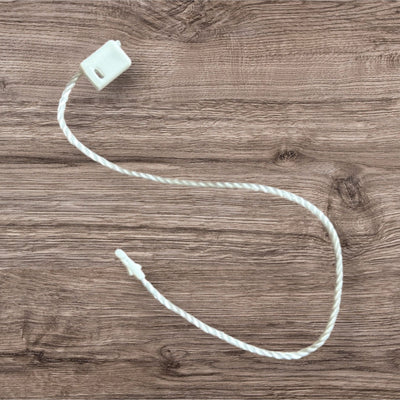
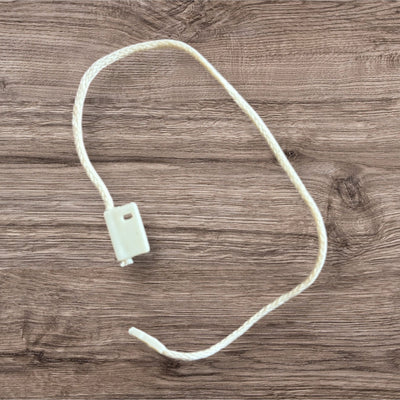
| Nylon tie / plastic fastener | Functional, nearly invisible | Good | Lowest | Mass volumes, fast processing |


The options up close
Cotton cord
The most versatile choice. Usually around 1–2 mm thick, in white, ecru, black or a brand colour. It's soft, won't scratch fabric and looks natural. It suits most boards, especially uncoated and kraft.
Waxed cotton cord
Cotton cord impregnated with wax. The wax makes it smoother, stiffer and tougher – it won't fray and the knot stays tight. It's commonly available in natural, black, red and green. Ideal for denim and leather, where the tag tends to be heavier.
Jute and twine
Natural plant fibres with a coarse texture. They look authentic and handmade, but can shed fibres onto dark or delicate fabrics. They work well with kraft tags and eco-positioned brands.
Elastic loop
A thin elastic tied with a knot or a small metal crimp. Because it stretches, the tag can be looped over a strap or button without piercing the fabric. Popular for swimwear and lingerie.
Satin ribbon
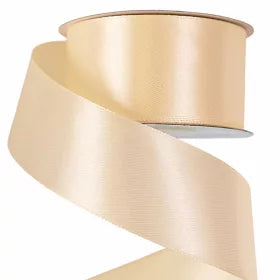
A glossy polyester ribbon that instantly adds a festive, luxurious feel. For tags, narrow widths of about 3–10 mm are typical. Our satin ribbons come in a wide range of colours and widths from 0.3 to 7 cm.
Grosgrain ribbon
A ribbon with pronounced crosswise ribs and a matte finish. It's stronger than satin and doesn't slip, so knots hold well. Excellent for menswear, shirts and classic brands. You'll find grosgrain in the same Ribbons collection.
Cotton herringbone tape
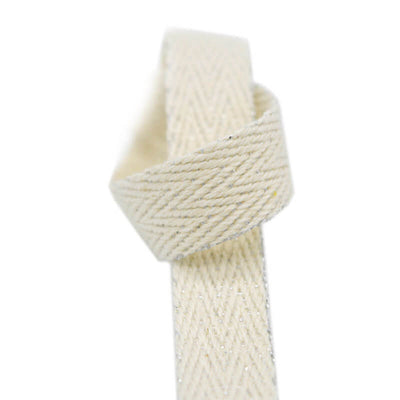
A flat cotton tape with a herringbone weave. It looks crafted and natural – a good fit for brands that want something wider than cord but without the shine of satin.
Nylon tie and plastic fastener
The functional choice of mass retail. A plastic fastener goes in with a tagging gun in a second, while a nylon string with a plastic seal (a string lock) snaps shut and can't be reopened without cutting. They look utilitarian, but they're unbeatable for thousands of pieces and for products where tags must not be swapped.
Matching string to garment
- T-shirts and basics: neutral cotton cord, or a plastic fastener through the seam label.
- Jeans: waxed cord or jute, attached to a belt loop.
- Dresses and blouses: narrow satin ribbon in the tag's colour.
- Men's shirts and jackets: grosgrain ribbon through a buttonhole.
- Knitwear: a safety pin with string through the sewn-in label – no pierced loops.
- Swimwear and lingerie: an elastic loop around the strap.
Choosing a colour
- Tone on tone – black string on black board, ecru on kraft. Clean and expensive-looking.
- Brand accent colour – if your brand owns a colour, the string is a cheap way to show it on every garment.
- One neutral for everything – a single colour (black, white or natural) across the range simplifies stock and ordering.
- Careful with pale garments – dark strings that aren't colourfast can mark white fabric if they get damp. Choose a light string or check colourfastness.
How long should it be?
For a tag loop, cord is usually cut at around 15–20 cm, which after folding and knotting gives a loop of roughly 7–10 cm. A shorter loop keeps the tag close to the garment and suits collars and sleeves. A longer one lets the tag hang freely and read easily – good for jeans and outerwear.
Tip: before ordering in bulk, attach a sample tag to a garment on a hanger and photograph it from the front. You'll see immediately whether the tag hangs where it should.
Pre-tied loops or on the roll?
- Pre-tied loops – knotted, or finished with a plastic or metal crimp. Fast to attach, consistent, convenient for hundreds or thousands of pieces.
- On the roll – more flexible and often better value for small quantities, but you cut and tie by hand.
- Safety pin with string – pinned through the seam label; handy for knitwear and delicate fabrics.
Ribbons are usually used from the roll: cut a length, thread it through the hole and tie a bow or a simple knot. Cut satin ends on the diagonal or seal them lightly with heat so they don't fray.
FAQ
What's the cheapest option?
A plastic fastener applied with a tagging gun – it's the retail standard because it's so fast. But if you want the tag to be part of the experience, cotton cord is the smallest upgrade customers actually notice.
Can the string carry a logo?
Yes – a woven or printed ribbon with your logo is a strong branding element. For custom options, contact us.
Should the string match the stitching and trims?
It isn't required, but it looks better. With contrast topstitching, a string in the same colour makes the garment feel more finished. Match metal tones with your buttons and hardware, too.
Do you sell hang tag strings?
Yes. Our Labels collection includes hang tag strings in a range of colours, lengths and thicknesses.
Bul-tex manufactures and supplies garment trims – ribbons, labels, strings – and accepts custom orders for brands. We ship across the EU with DHL Express. For more ideas, see our ribbon articles.