A jacquard label is the small piece of fabric at the neck or in a seam that, for many shoppers, is the first sign of a garment's quality. Unlike a printed label, the logo and lettering on a jacquard label are not applied to the surface; they are woven into the structure of the label itself. That's why it doesn't fade or peel and still looks the same after dozens of washes. In this article we explain how the technique works, what the terms jacquard and damask mean, and when a jacquard label is the best choice for your brand.
How the image is created
Every woven label is made of warp threads running lengthways and weft threads interlacing across them. In jacquard weaving the loom controls each warp thread individually, so at every point it can decide which colour of weft shows on the face. The logo is built from coloured yarns, not ink. The technique is named after Joseph Marie Jacquard, who in the early 19th century created a punched-card mechanism to control the loom; today the same job is done digitally.
In short: print sits on top of a label, jacquard is the label.
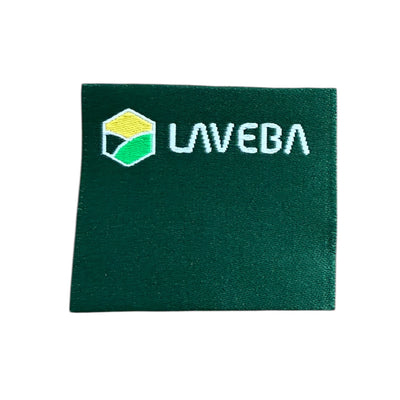
 Woven label 3.4 cm x 4.4 cm - brand, logo
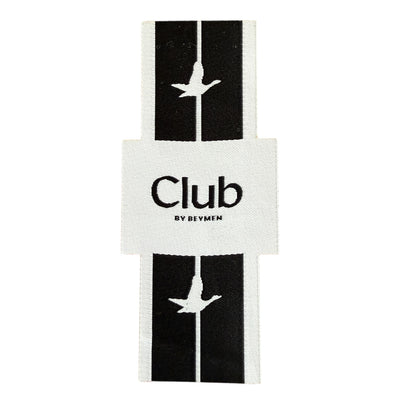
 Jacquard woven label LBL 0055 6 x 5 cm – white background with black letters, soft premium design, with logo
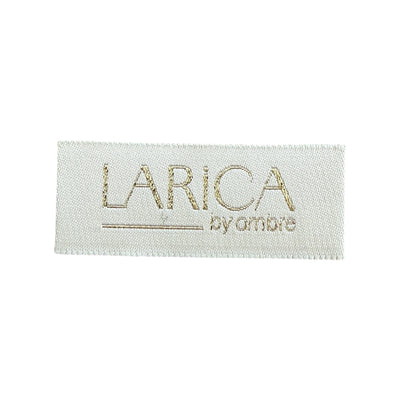
 Jacquard woven label LBL 0021 7.5 x 6 cm – personalized with logo
Quick glossary
- Jacquard label: a general term for a woven label whose image is produced by jacquard weaving. Often used as a synonym for "woven label".
- Damask: a woven label quality using many fine, low-denier yarns at high density. It gives the best detail and the softest handle.
- Taffeta: a looser, cheaper weave. Good for simple text and size labels.
- Satin weave: a label with a smooth, slightly shiny base and medium detail.
- Denier: a measure of yarn thickness. Lower denier means a finer yarn and finer detail.
- Density: the number of weft picks per centimetre. The higher it is, the crisper thin lines become.
- Raised lettering: an effect where part of the design is woven more densely so it stands proud of the base.
Why brands choose jacquard labels
1. Durability
Because the image is made of yarn, it stands up to washing, ironing and abrasion. Printed labels can show cracked ink after many hot washes; a woven label simply doesn't have that problem.
2. Perceived quality
Shoppers touch the label when they check the size. A dense, soft jacquard label with clean outlines signals attention to detail, which is why almost every established clothing brand uses a woven label for its main branding.
3. Detail
Damask allows small text, thin lines and fairly complex logos. There are limits, which we cover below.
4. Effects
Metallic yarns for a gold or silver effect, neon colours, raised lettering and double-sided designs are all possible in weaving. In our catalogue you'll find jacquard labels with a gold effect, black bases with white lettering and double-sided options.
Limitations worth knowing
- Number of colours. A label uses a limited set of coloured yarns; the cleanest results come from 2 to 5 colours.
- Gradients and photos. Smooth transitions and photographs don't reproduce well. A printed label is a better fit.
- Very small text. Below roughly 6 pt, lettering loses legibility even on damask.
- Colour matching. Colour depends on available yarns, so expect the "closest shade" rather than an exact Pantone match.
When a jacquard label is the best choice
| Situation | Jacquard label? | Why |
|---|---|---|
| Main brand label at the neck | Yes | Durable with a premium look |
| Children's and baby clothing | Yes, damask | Soft with clean edges |
| Denim, jackets, bags | Yes, or a metal label | Handles heavy use |
| Composition label in 5 languages | Probably not | Printed satin holds more text |
| Logo with a photo or gradient | No | Printed canvas or satin works better |
| Trial run of a few pieces | Depends | Weaving has a minimum order quantity |
Jacquard vs printed labels
A printed label, whether satin or canvas, is more flexible with colour, handles gradients and fits lots of text into a small area. A jacquard label wins on durability, perceived quality and the fact that its image can't wear off. That's why most brands combine the two: a woven jacquard label for the brand at the neck and a printed satin label for composition and care in the side seam.
Sizes and folds
Most brand labels fall between 4 x 2 cm and 8 x 4 cm, while wide labels for jackets and bags can be 10 x 9 cm or larger. Choose the fold to suit where it's sewn: a flat label stitched on all four sides, an end fold for necks and pockets, a centre fold for a two-sided label and a mitre fold for a hanger loop. Our article on label folds goes into more detail.
How to order a jacquard label
- Prepare your logo as a vector file (AI, PDF, SVG).
- Decide on size, fold and base colour.
- Limit the colours and make sure the smallest text is at least around 6 pt.
- Approve the digital proof.
- Confirm quantity and lead time, as weaving has a minimum order quantity.
Jacquard labels from Bul-tex
Bul-tex manufactures and supplies woven jacquard labels with the customer's logo, including raised lettering, metallic effects, double-sided designs and a range of base colours. See the designs in our labels collection, and to complete your branded look browse our buttons and ribbons. For your own design, contact us. There's more advice in our label articles.
Frequently asked questions
Are jacquard and woven labels the same thing?
In practice, yes. Any woven label with an image is produced on the jacquard principle. The differences between types come from the weave: taffeta, damask or satin.
Are jacquard labels scratchy?
Damask is the softest option. Irritation usually comes from a cut edge, which is why folded labels or sealed edges are preferred at the neck.
How long does a jacquard label last?
Usually as long as the garment itself, because the image is made of yarn rather than ink.