A textile composition label is the one label on a garment that EU law explicitly makes mandatory. Regulation (EU) No 1007/2011 sets out when a fibre label is required, which fibre names you are allowed to use, how percentages must be listed and how the label has to be attached. For a small brand or atelier launching a first collection it can look like red tape, but the rules are short and fairly logical once you see them laid out. This guide walks through them one by one and ends with a checklist you can run before ordering your labels.
Which products are in scope
The regulation applies to textile products when they are made available on the EU market (Article 2). A textile product is any raw, semi-worked or finished product made exclusively of textile fibres. The important extension is that products containing at least 80% textile fibres by weight are treated the same way, so a fabric bag with metal hardware or a garment with leather appliqués is still covered if textile dominates.
There are exemptions. Annex V lists products for which fibre labelling is not mandatory, such as toys, disposable items, textile parts of footwear and a range of small articles. If you sew clothing, underwear, home textiles or fabric accessories, you are almost certainly in scope.
 Jacquard woven label LBL 0057 5 x 4.5 cm – double-sided white with blue letters, soft premium design, with logo
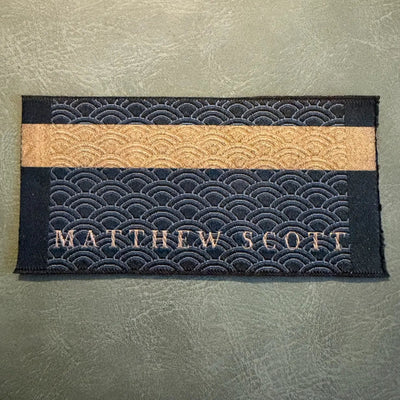
 Jacquard woven label LBL 0023 8 x 4 cm – premium wavy design, personalized with logo
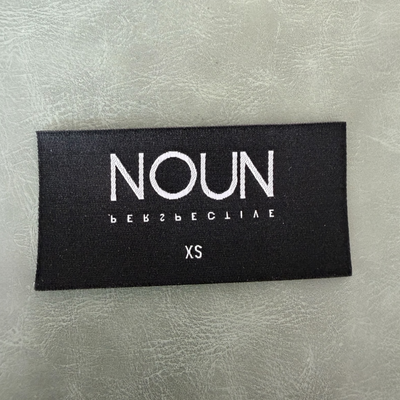
 Jacquard woven label LBL 0044 8 x 4 cm – black background with white woven letters, unique design, soft premium style, with logo
What the label must actually say
1. Only legally recognised fibre names
Article 5 requires fibre compositions to be described using only the names listed in Annex I: cotton, flax (linen), wool, silk, polyester, polyamide, viscose, elastane, acrylic and so on. Do not replace the fibre name with marketing terms like "microfibre" or "bamboo fabric". A fibre brand name may appear immediately before or after the legal name, but never instead of it.
2. Percentages by weight, in descending order
For blends, every fibre must be listed by name and percentage by weight, from largest to smallest (Article 9). So it is "65% polyester, 35% cotton", not the other way round. The regulation allows a manufacturing tolerance of 3% between the declared composition and the figure obtained by lab analysis (Article 20); our separate article on fibre percentages covers this in detail.
3. "100%" only for a single fibre
The words "100%", "pure" or "all" may only be used when the product is composed exclusively of one fibre (Article 7). Up to 2% of extraneous fibres by weight is tolerated if technically unavoidable under good manufacturing practice.
4. Separate compositions for separate components
If a product has two or more textile components with different fibre contents, such as a shell and a lining, the composition of each must be stated (Article 11). Components under 30% of the total weight that are not main linings can be left out.
5. Non-textile parts of animal origin
If there is leather, fur or feathers as non-textile parts, the label must carry the phrase "Contains non-textile parts of animal origin" (Article 12).
How the label must look and be attached
Article 14 says the label or marking must be durable, easily legible, visible and accessible and, in the case of a label, securely attached. In practice that means a label that survives washing and ironing without the text disappearing, which is why sewn-in printed satin labels or woven labels are the standard for clothing rather than paper stickers.
Article 16 adds that composition information must be printed in a uniform font, size and style and kept clearly separate from other information. It must also be visible to the buyer before purchase, including in an online shop. The language is the official language of the member state where the product reaches the consumer, so a garment sold in Bulgaria needs its composition in Bulgarian, and one sold in Germany needs German. We cover multilingual labels in a separate article.
Tip: in business-to-business supply (for example when you sell to a retailer) the label can be replaced by commercial documents (Article 14(2)). When selling to the end consumer, a label or marking is mandatory.
Who is responsible for the label
Under Article 15 the manufacturer is responsible for supplying the label and for the accuracy of its content. An importer or distributor who places a product on the market under its own name or trade mark, or attaches its own label, is treated as the manufacturer. Retailers must also make sure the products they sell carry the right labelling. If you produce garments for another brand, agree in writing who supplies the label content.
What the regulation does not require
Regulation 1007/2011 only covers fibre composition. It does not make care symbols, size or "Made in" mandatory. Care symbols (based on ISO 3758) are voluntary at EU level, but shoppers expect them and some countries have national rules of their own. General product safety and consumer law also require manufacturer or importer details, which is why most brands put them on the same label.
Checklist before ordering composition labels
- Confirm the product contains at least 80% textile fibres and is not listed in Annex V.
- Get the exact composition by weight from your fabric supplier, not a visual guess.
- Use the Annex I fibre names, listed in descending order.
- Only use "100%" for single-fibre products.
- State lining and other main components separately.
- Prepare the text in the language of every country you sell in.
- Choose a label material that lasts as many washes as the garment.
- Decide where it will be sewn, usually into the side seam or below the brand label.
- Leave room for care symbols and manufacturer details.
- Show the same composition on your online product page.
Which label type to use for composition
Composition and care labels are usually printed satin or polyester labels, because they hold a lot of text in several languages, stay soft and don't irritate the skin. The brand label at the neck is typically woven, jacquard or printed canvas. You'll find woven, satin, canvas and metal options in our labels collection, and decorative and functional tapes among our ribbons. For more practical guides, browse our label articles.
You can read the full text of the regulation on EUR-Lex. If you are preparing your own composition or brand labels, Bul-tex manufactures and supplies labels to the customer's design. Get in touch with your sizes and text and we will suggest a suitable material.
Frequently asked questions
Does a handmade garment sold on Etsy or Instagram need a composition label?
Yes. The regulation makes no distinction between a large manufacturer and a small studio: if the product is made available on the EU market, it needs a fibre label or marking.
Can the composition be printed only on the packaging?
For most garments, no, because the marking must be durable and stay with the product. Only certain products listed in the regulation can rely on inclusive labelling on the packaging.
Can I write "PES" instead of "polyester"?
It is safer to spell out the full Annex I name in the local language. Abbreviations are not among the legal fibre names and may be considered unclear by inspectors.