EU clothing labelling requirements are one of the few things in fashion that aren't a matter of taste but of law. Across the European Union, fibre composition labelling is governed by Regulation (EU) No 1007/2011 on textile fibre names and the labelling of textile products. Yet many small brands mix up the two kinds of label – the sewn-in one and the hang tag – and risk trouble with inspectors or with retailers who refuse the goods. In this article we separate myths from facts and finish with a practical checklist.
Important: this is general information, not legal advice. For specific products – kidswear, items with leather or feathers, workwear – check the current text of the regulation or consult a specialist.
What the regulation says, in short
- Textile products may only be made available on the market if they are labelled or marked with their fibre composition.
- The labelling must be durable, easily legible, visible and accessible, and where it is a label, securely attached.
- Only the fibre names listed in Annex I of the regulation may be used (cotton, wool, polyester, polyamide, elastane and so on). Fibre trade marks may sit alongside them, but never replace them.
- In blends, fibres are listed in descending order of weight percentage.
- A product made entirely of one fibre may be described as "100%", "pure" or "all".
- Fibre names must be given in the official language or languages of the member state where the product is sold to the consumer.
The full text is available on EUR-Lex.
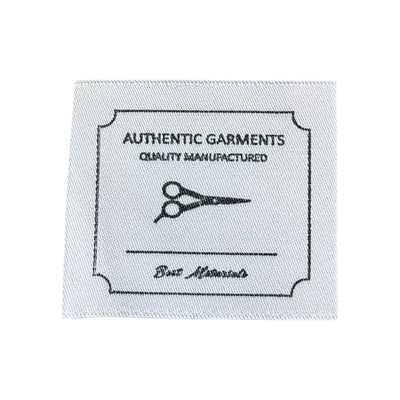
 Square woven label 5 x 5 cm PLBL 0001 – custom design production
 Satin label 14 cm x 4 cm – print on satin ribbon
 Woven label 10 cm x 9 cm – folded, double-sided
Myths and facts
Myth 1: "Composition can go on the hang tag alone."
Fact: A hang tag comes off the first time the garment is worn, so it doesn't meet the requirement for a durable, securely attached label. A removable swing tag therefore cannot be the primary location for fibre composition. You can repeat the composition on the tag for the shopper's convenience, but the sewn-in label is required.
Myth 2: "Care symbols are mandatory."
Fact: At EU level, care labelling is voluntary. In practice nearly every retailer and shopper expects it, and wrong instructions can lead to returns. If you include them, use the symbols defined in ISO 3758.
Myth 3: "Size labelling is a legal requirement."
Fact: The regulation doesn't require a size. It's a commercial necessity, and the EN 13402 sizing system is voluntary.
Myth 4: "If the lining is a different fabric, I don't need to list it."
Fact: For multi-component products, composition is given for each component – for example "Shell: 100% wool; Lining: 100% viscose". Some parts, such as small decorative trims, may be left out if they make up only a minor share of the weight – check the rules for your case.
Myth 5: "Leather trims aren't textile, so they don't affect me."
Fact: If a product contains non-textile parts of animal origin – leather, fur, feathers, bone, horn – the label must carry the phrase "Contains non-textile parts of animal origin". A general wording can't replace it.
Myth 6: "I can write polyester as 'poly'."
Fact: Abbreviations aren't allowed for fibre names. Use the full name in the relevant language.
What applies specifically in Bulgaria
On top of the EU regulation, Bulgaria's Consumer Protection Act requires traders to offer goods with labels and information in Bulgarian. In practice, for garments sold in Bulgaria the composition on the sewn-in label must also appear in Bulgarian. If you sell in several countries, multilingual labels are standard practice: list the languages in a consistent order with a clear separator.
The EU's "Your Europe" page on textile labelling is a useful starting point and is available in all EU languages, including Bulgarian.
Sewn-in label or hang tag: what goes where
| Information | Sewn-in label | Hang tag | Status |
|---|---|---|---|
| Fibre composition | Yes | May be repeated | Mandatory |
| "Contains non-textile parts of animal origin" | Yes | May be repeated | Mandatory where applicable |
| Care symbols | Yes | Optional | Voluntary but expected |
| Size | Yes | Yes | Commercial practice |
| Manufacturer name and contact address | Possible | Possible (or packaging) | Required under product safety rules |
| Price, barcode, SKU | No | Yes | Commercial practice |
| Logo, brand story | Logo optional | Yes | Marketing |
Under the General Product Safety Regulation (EU) 2023/988, the product, its packaging or an accompanying document must show the manufacturer's name and contact address, plus a product identifier such as a model or batch number. For clothing this is usually handled through the sewn-in label, or the hang tag together with the packaging.
What the sewn-in label should be like
To count as durable and easily legible, the label has to survive repeated washing without the text fading or the edges fraying. Practical options:
- Printed satin label – soft and smooth, good for longer text and care symbols.
- Woven (jacquard) label – the text is woven in and can't wash off; ideal for your brand logo.
- Printed canvas or cotton tape – a natural look for eco-positioned brands.
The label should be sewn in so it can't be removed without damage – typically in a side seam or the neck seam. Browse our woven and satin labels.
Practical checklist
- Composition is on a sewn-in, durably attached label.
- Only Annex I fibre names are used, with no abbreviations.
- Percentages run in descending order and add up to 100%.
- Each main component (shell, lining, filling) has its own composition.
- The text is in Bulgarian for sale in Bulgaria, plus any other languages needed.
- The animal-origin phrase is included where it applies.
- The manufacturer's name and contact address appear on the product or packaging.
- The hang tag repeats the composition only as an extra.
FAQ
Do the rules apply to online sales too?
Yes. Besides the label on the product, when you sell online the composition must be available to the buyer before purchase – usually in the product description.
Can composition be printed directly on the fabric?
Yes, the regulation also allows marking – for example a print on the inside of a T-shirt. What matters is that it is durable, legible and survives washing.
What if I don't know the exact composition of my fabric?
Ask the fabric supplier for a specification. Responsibility for an accurate label lies with whoever places the product on the market.
Bul-tex manufactures and supplies labels and garment trims and accepts custom orders for brands. If you need sewn-in composition or logo labels, contact us. More production articles are in our manufacturing section.